Most Data Scientists underestimate how much communication affects technical interview outcomes.
Candidates usually prepare algorithms, ML theory, SQL, experimentation, or system design. But during the interview, the real challenge is different:
Can another human follow your thinking in real time?
In English-language interviews, many technically strong candidates sound less senior than they actually are because their explanations become:
- too dense,
- too abstract,
- too fast,
- or overloaded with terminology.
A hiring manager rarely rejects someone for not naming one obscure metric. They reject when communication creates uncertainty.
What interviewers are actually evaluating
Technical interviews for Data Scientists usually operate on three parallel layers:
Technical accuracy
- Are your concepts correct?
- Do you understand tradeoffs?
- Can you reason through ambiguity?
Communication clarity
- Can people follow your explanation?
- Do you structure ideas clearly?
- Can you avoid over-explaining?
Business relevance
- Do you connect models to outcomes?
- Can you prioritise impact?
- Do you sound product-aware?
Many candidates prepare almost entirely for Layer 1.
Senior candidates usually separate themselves on Layers 2 and 3.
Key insight: Interviewers are listening for signal efficiency. Strong communication makes your technical depth easier to trust.
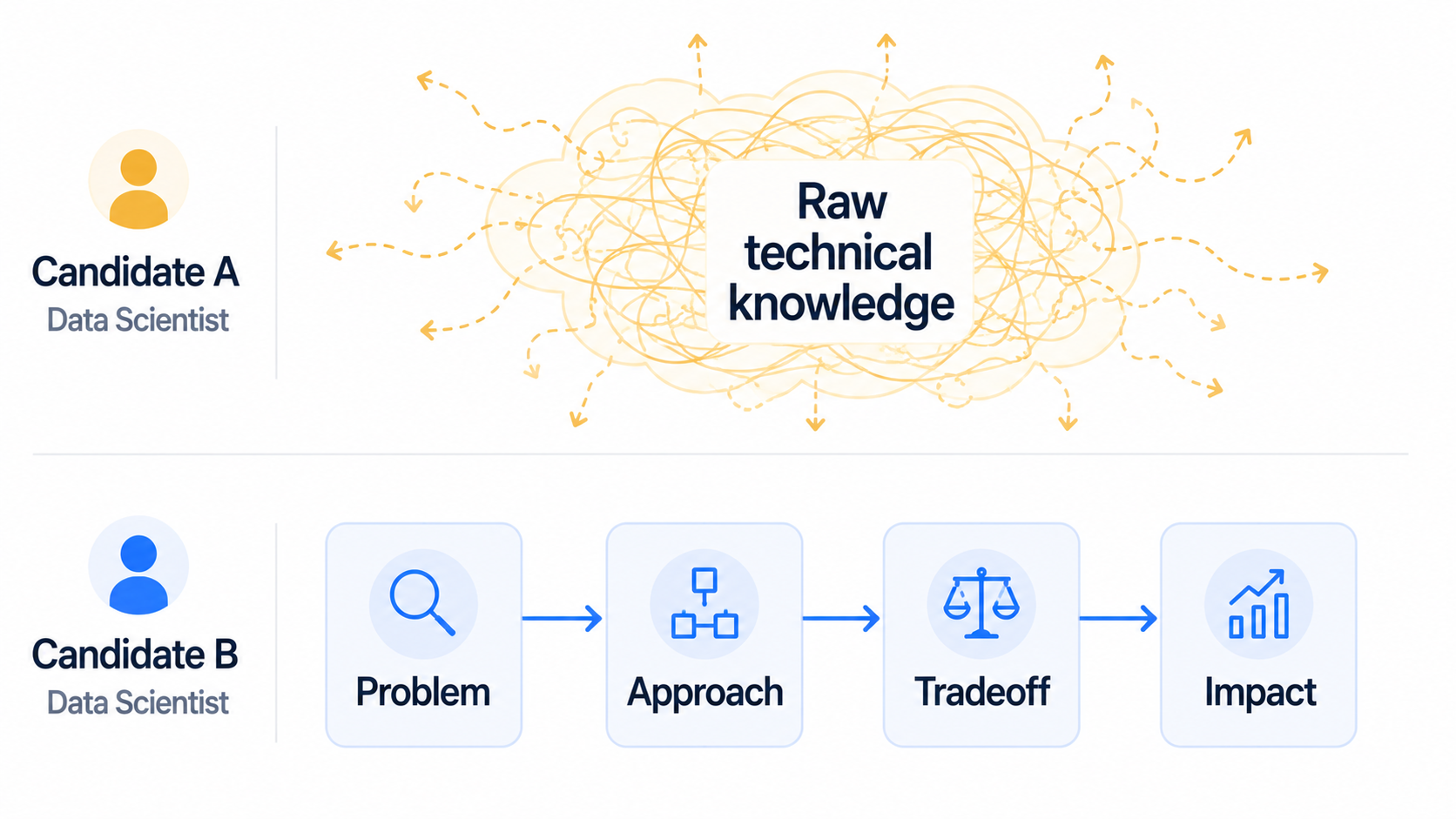
The most common communication failure
A common failure mode in Data Science interviews sounds like this:
“So first we trained several ensemble approaches and then we compared ROC-AUC and precision recall curves and then we tuned hyperparameters and also we had data imbalance and…”
Nothing is technically wrong.
But the interviewer has already lost the thread.
The problem is not English grammar.
The problem is cognitive overload.
Strong communicators reduce cognitive load. They guide the interviewer through the explanation instead of dumping information.