A lot of candidates try to make interviews sound smooth by removing every pause. They rush to answer quickly, keep talking while they think, and fill every small gap with words that do not really add anything.
That instinct is understandable. Silence feels risky when you are being evaluated. But in interviews, a calm pause usually does the opposite of what candidates fear: it makes you sound more deliberate, more structured, and more in control.
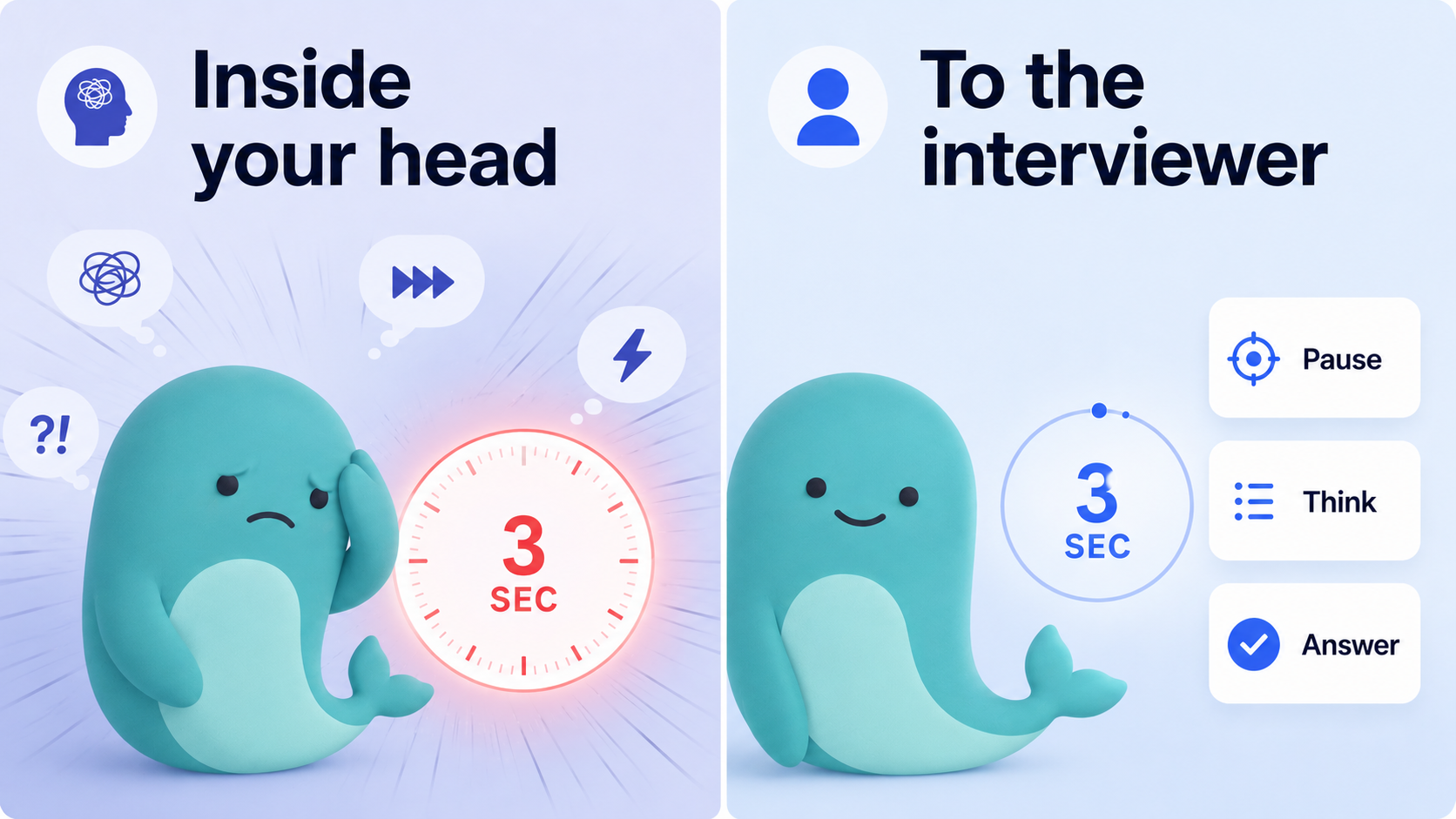
The strange part is that the pause often feels much longer to you than it does to the interviewer. Inside your head, it can feel like a small disaster. From the outside, it often looks like a person who is thinking carefully.
Why silence feels risky to the speaker
Most candidates do not fear silence itself. They fear what silence might mean.
A pause can feel like proof that you forgot the answer, lost your structure, or exposed uncertainty. That is why so many people start speaking too fast right after a question lands. They are not trying to be unhelpful. They are trying to escape the discomfort of thinking in public.
The problem is that the faster you rush, the less room your brain has to organize the answer. You begin speaking before the idea is ready, and the result is usually more fillers, more repetition, and less clarity. What felt like protection ends up creating the exact impression you wanted to avoid.
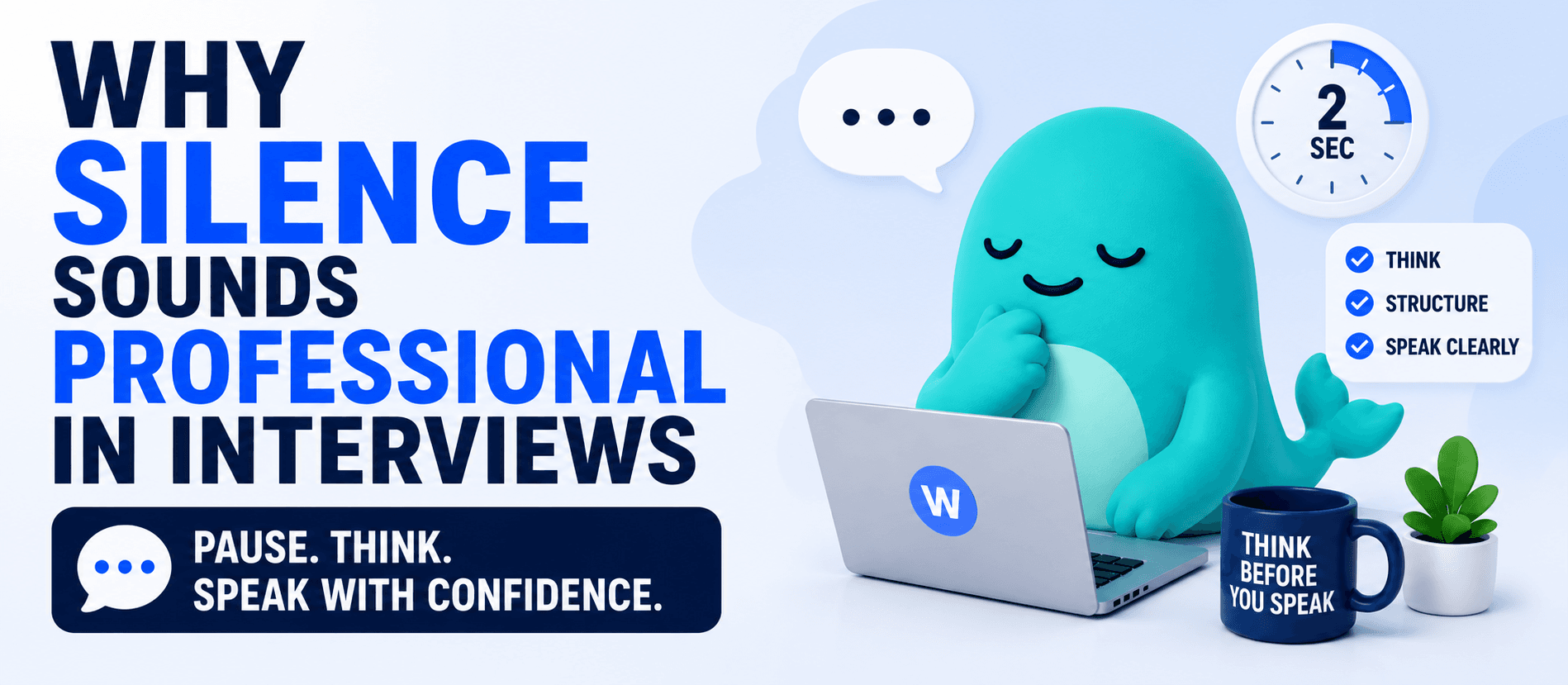
Silence works because it reduces internal pressure. It gives your working memory a second to catch up with the question, your breath, and the structure of the answer. In practice, that tiny gap often makes the whole response sound cleaner.
Key insight: Silence feels like hesitation when you are speaking, but it often sounds like control when someone else is listening.
Where professional silence shows up
Professional speakers do not eliminate silence. They place it.
The most useful pauses usually happen in three places. Before the answer starts, silence helps you frame the response. Between major points, it creates shape. After a correction or a difficult moment, it gives the conversation room to settle instead of spiraling.
- Before answering: a brief pause signals that you are thinking, not reacting.
- Between ideas: silence marks transitions and makes the answer easier to follow.
- After a mistake: a pause prevents panic from turning one weak moment into three more.
This is one reason interviewers often prefer candidates who sound a little slower but clearer. They are easier to follow. They seem more organized. And they rarely give the impression that they are speaking just to avoid thinking.
Why silence sounds confident to interviewers
Interviewers do not only listen to your words. They also listen for how you manage uncertainty.
A candidate who pauses before answering usually sounds more composed than a candidate who starts instantly and then unravels halfway through. That is because silence suggests there is a process happening. Even if the answer is still forming, the listener can sense that the speaker is deciding deliberately rather than improvising under pressure.
This matters especially in English interviews. Non-native speakers often feel they need to prove fluency by speaking continuously. But constant speech is not the same thing as confident communication. In many cases, the more professional move is to slow down, let the question land, and answer with shape instead of noise.
Silence also makes your actual words more valuable. When every sentence arrives too quickly, the listener has less time to absorb the point. When there is room around the words, the structure becomes easier to hear. The answer feels cleaner even if it is not longer.
Why this matters: In interviews, people often confuse “smooth” with “fast.” In practice, sounding professional usually means sounding clear enough that the interviewer can follow your thinking without effort.
How to use silence without sounding awkward
The goal is not to freeze dramatically and stare at the floor. The goal is to make silence feel like part of your delivery.
A good pause is brief, deliberate, and quiet. It is not nervous fidgeting. It is not a half-started sentence. It is a moment where you collect the next idea before speaking it.
One helpful pattern is to let the pause happen after the question, not in the middle of the first sentence. If you begin with a clear opening like “I would approach this in two parts” or “The main thing I’d highlight is…”, the silence feels like preparation rather than confusion. That small move often gives the whole answer a more executive, composed tone.
Another useful habit is to pause when your answer changes direction. Many weak answers become hard to follow because the speaker keeps moving without marking transitions. A tiny pause before the next point gives the listener a reset and gives you a second to check the structure.
How to practice silence until it stops feeling strange
Silence gets easier when your brain learns that it is safe.
The simplest training is also the least glamorous: record yourself answering one common interview question and deliberately insert one to two second pauses. Do not try to sound polished on the first pass. Just notice how often you want to fill the space immediately.
Most candidates are shocked by how often they talk too soon. They hear one tiny pause in the recording and feel like they were silent for an eternity. In reality, the pause usually sounds calm and perfectly normal.
That mismatch is the whole lesson.
You can train it with a few short sessions:
- answer a question out loud,
- pause before the first sentence,
- pause once between two main points,
- and end without rushing into a closing filler.
After a few repetitions, the pause starts to feel less like a gap and more like a tool. That is the moment it becomes useful in a real interview.
Practical target: Aim for pauses that are intentional, not accidental. If the silence is doing a job — giving you structure, breathing room, or a cleaner transition — it will usually sound professional rather than awkward.
The strongest speakers do not avoid silence — they control it
Silence is only uncomfortable when it feels unplanned. Once it becomes a deliberate part of your communication, it stops reading as uncertainty and starts reading as judgment.
That is why strong interview speakers often sound calmer even when they are thinking hard. They are not trying to prove something with nonstop speech. They are giving their answer room to breathe. And that room is often what makes the answer sound senior, composed, and easy to trust.
The next time a question lands, do not rush to escape the pause. Use it. Let the idea form. Then answer with structure.
That is usually what professionalism sounds like.