You prepared for the interview. You reviewed your projects, practiced common questions, maybe even rehearsed answers out loud.
Then the interviewer asks something simple.
And suddenly your mind goes completely blank.
Not partially blank. Completely blank.
You lose your structure. Your vocabulary disappears. Your thoughts feel tangled. Even questions you answered perfectly yesterday now feel strangely difficult.
This experience is incredibly common in English-language interviews — especially for non-native speakers in technical roles. And despite how personal it feels in the moment, it usually has very little to do with intelligence or preparation.
Your brain isn't failing.
It's overloaded.
Why interviews overload your brain faster than normal conversations
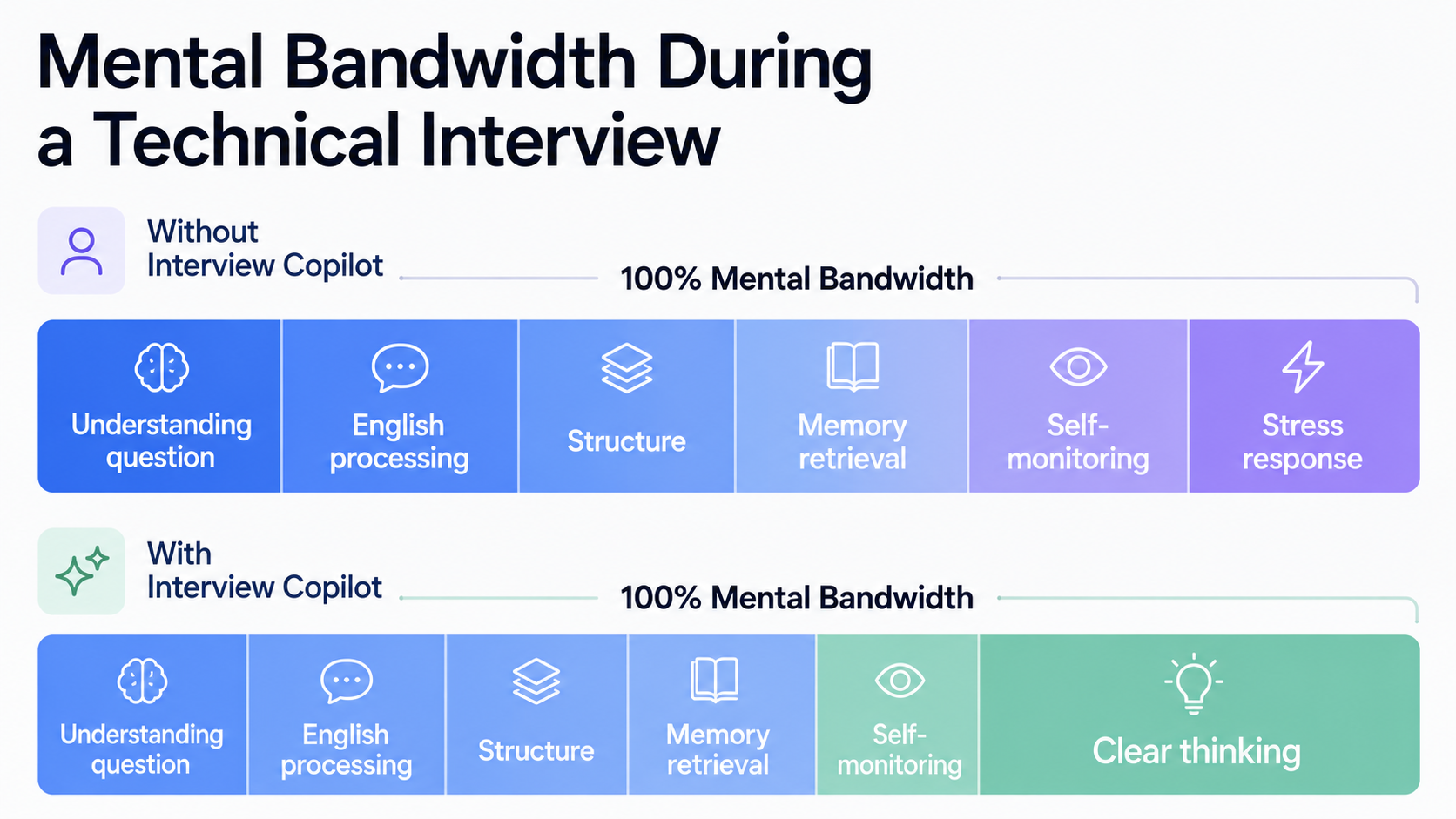
A technical interview creates an unusual amount of simultaneous cognitive pressure.
You're trying to:
- understand the question,
- translate ideas into English,
- organize the answer,
- monitor grammar and pronunciation,
- remember relevant examples,
- manage pacing,
- and evaluate the interviewer's reactions at the same time.
In normal conversation, these processes become semi-automatic. In interviews, stress pushes many of them back into conscious control — which dramatically increases mental load.
The result is what psychologists sometimes call a working memory bottleneck. Your brain has the knowledge somewhere — but the temporary mental workspace required to retrieve and express it becomes saturated.
That's why candidates often say:
“I knew the answer after the interview ended.”
Of course you did. The pressure disappeared.
Key insight: Going blank usually isn't a knowledge problem. It's a bandwidth problem. Your brain temporarily loses retrieval capacity under stress and language load.
Stress changes how your memory works
During high-pressure situations, the brain prioritizes threat detection over flexible recall.
That sounds dramatic, but interviews trigger many of the same stress mechanisms as public speaking or performance evaluation. Your nervous system interprets uncertainty and judgment as risk.
This is why your body may suddenly feel different before interviews:
- shallow breathing,
- dry mouth,
- faster heart rate,
- tension in the chest,
- racing thoughts,
- difficulty concentrating.
These aren't random symptoms. They're part of the same system.
And unfortunately, stress affects precisely the type of thinking interviews require most: structured retrieval and verbal organization.
A relaxed brain retrieves information broadly and flexibly. A stressed brain narrows focus and becomes more reactive. That's useful if you're escaping danger. It's terrible for explaining a product decision or walking through a SQL query.
Why speaking English makes the problem worse
Even advanced English speakers experience this.
The issue isn't simply vocabulary size. It's processing speed under pressure.
In your native language, many communication tasks are deeply automated. You don't consciously think about sentence construction or transition phrases. Your brain can focus almost entirely on ideas.
In English, even fluent professionals often still allocate part of their mental bandwidth to language mechanics:
- selecting precise wording,
- checking tense consistency,
- monitoring pronunciation,
- adjusting pace,
- avoiding mistakes.
Normally this is manageable.
But under interview stress, the margin disappears.
That's why candidates frequently describe a strange feeling:
“I sound less intelligent in English interviews than I actually am.”
They're often correct. Not because they lack expertise — but because cognitive overload reduces expressive bandwidth.
The hidden role of self-monitoring
One of the biggest contributors to mental freezing is excessive self-monitoring while speaking.
Many candidates unconsciously split their attention between:
- answering the question,
- and evaluating how they're performing.
The internal dialogue becomes constant:
“Was that sentence wrong?”
“I'm speaking too slowly.”
“That answer sounds stupid.”
“I forgot the word.”
“They're probably unimpressed.”
This mental commentary consumes working memory in real time.
Ironically, the harder you try to control every detail of your speech, the harder speaking becomes.
Confident speakers aren't thinking more during interviews.
They're thinking less about themselves while speaking.
Why rehearsed answers sometimes fail unexpectedly
Candidates are often confused when answers they practiced suddenly collapse during real interviews.
This happens because memorized recall is fragile under pressure.
If your brain tries to retrieve an answer word-for-word, even one interruption can break the sequence:
- the interviewer phrases the question differently,
- asks a follow-up,
- interrupts midway,
- or changes the context slightly.
Now the memorized script no longer matches.
And because the answer wasn't deeply structured conceptually, the brain struggles to rebuild it dynamically.
This is why over-rehearsal sometimes creates a false sense of security. The goal isn't to memorize perfect wording. The goal is to develop flexible speaking structure.
Strong interview communicators usually rely on frameworks, not scripts.
For behavioural questions, they know the shape of the story:
- context,
- challenge,
- decision,
- outcome.
For technical explanations, they know the sequence:
- problem,
- reasoning,
- tradeoff,
- result.
The exact wording changes every time. The structure remains stable.
WhalePrep observation: Candidates who practice flexible speaking frameworks tend to recover from interruptions much faster than candidates relying on memorized answers.
Silence feels dangerous — but usually sounds confident
A major reason people freeze harder in interviews is panic around silence.
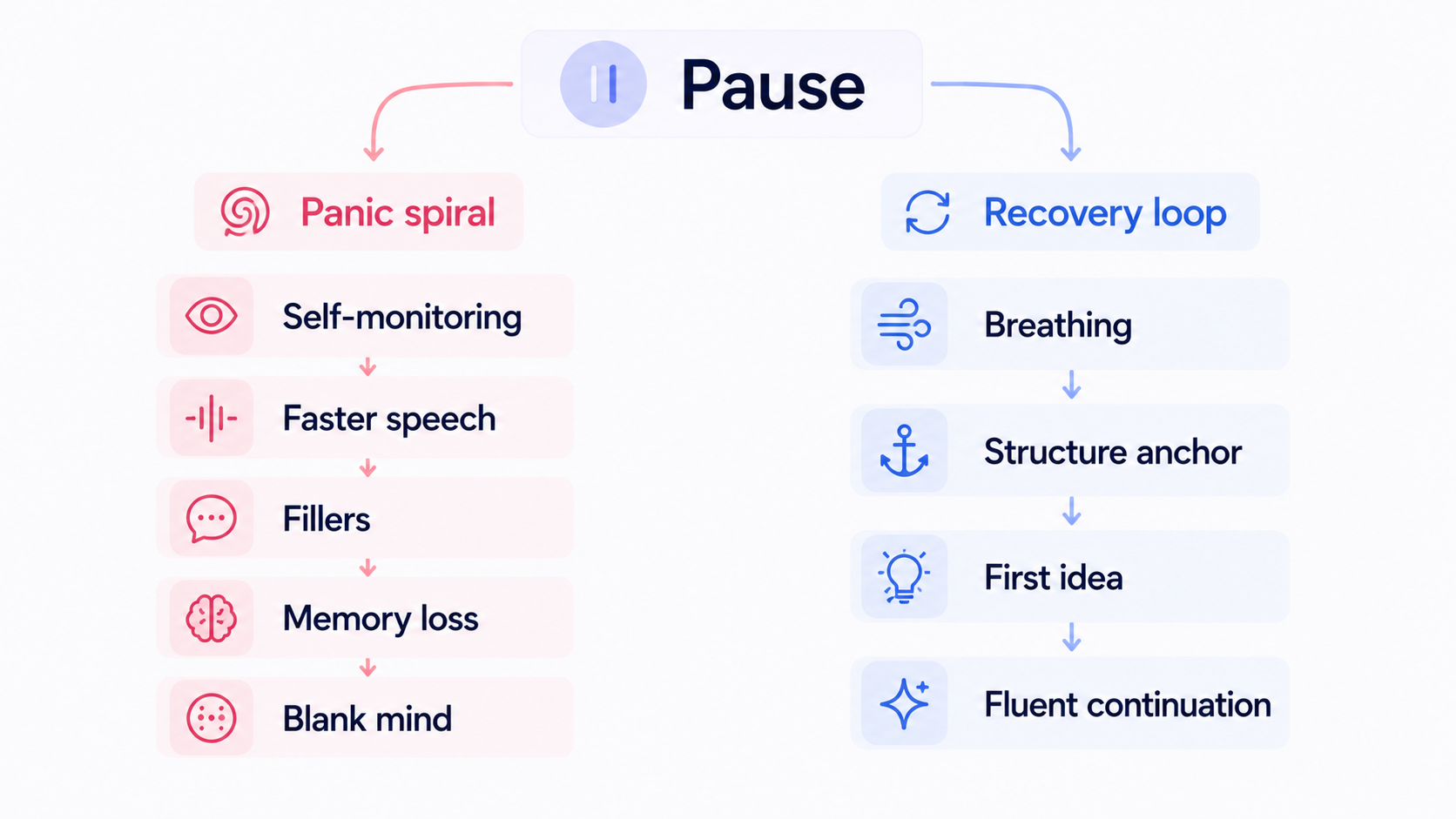
The moment your brain pauses for a second, many candidates rush to fill the gap: “um”, “so”, “basically”, “let me think”, nervous rambling, restarting sentences.
This creates even more overload.
Experienced interviewers, however, rarely interpret short pauses negatively. In fact, brief silence often reads as thoughtful composure.
The perception gap is important:
- to you, a 2-second pause feels painfully long;
- to the interviewer, it usually feels normal.
Learning to tolerate silence is one of the fastest ways to reduce mental spirals during interviews.
Instead of forcing immediate speech, strong candidates often:
- pause,
- breathe,
- anchor the structure,
- then begin calmly.
That tiny reset prevents cognitive chaos from cascading.
How to recover when your mind suddenly goes blank
The worst thing you can do after freezing is panic about freezing.
That secondary panic is what usually destroys the answer.
Recovery starts with reducing cognitive load immediately.
Slow the interaction down
You do not need to answer instantly.
A short pause before answering is completely acceptable in professional interviews. Especially for technical or behavioural questions.
Simple phrases help buy mental space naturally:
- “That's a good question.”
- “Let me think through that for a second.”
- “There are probably two parts to this.”
These aren't filler phrases when used intentionally. They're pacing tools.
Rebuild structure first, wording second
When people panic, they search for perfect sentences.
Instead, search for the next idea.
Don't ask:
“How do I say this perfectly?”
Ask:
“What's the first point I want to communicate?”
Once structure returns, language usually follows surprisingly quickly.
Narrow your focus
If your brain feels overloaded, stop monitoring everything simultaneously.
Don't think about:
- accent,
- grammar perfection,
- interviewer facial expressions,
- and answer elegance at the same time.
Focus only on delivering the next clear idea.
Communication quality improves dramatically when attention narrows.
The real skill is recovery, not perfection
One misconception hurts candidates badly: they believe strong communicators never freeze.
In reality, experienced speakers lose their train of thought too. They forget words. They pause. They restart sentences.
The difference is emotional recovery speed.
Weak interview performance often comes not from the original mistake — but from the internal spiral afterward:
“I messed up.”
“Now the interview is ruined.”
“I sound terrible.”
“I can't recover.”
Strong candidates recover faster because they don't catastrophize normal communication friction.
Interviewers usually care far less about minor speaking imperfections than candidates assume. Especially in technical hiring, clarity and composure matter much more than perfectly polished delivery.
Practice needs to simulate pressure — not just knowledge
Reading interview tips won't solve freezing.
Your brain needs repeated exposure to the actual speaking conditions that trigger overload:
- time pressure,
- English processing,
- uncertainty,
- live verbal explanation,
- being evaluated while thinking.
That's why passive preparation often creates false confidence. You feel prepared while reading notes — but the cognitive environment is completely different once speaking starts.
The most effective interview practice is spoken, timed, and slightly uncomfortable.
Short daily sessions work better than occasional marathon preparation because they gradually teach your nervous system:
“This situation is survivable.”
Over time, the brain stops treating interviews like threats and starts treating them like familiar tasks.
Practical target: Don't aim to eliminate nervousness completely. Aim to stay mentally functional while nervous. That's what confident interview performance actually looks like.