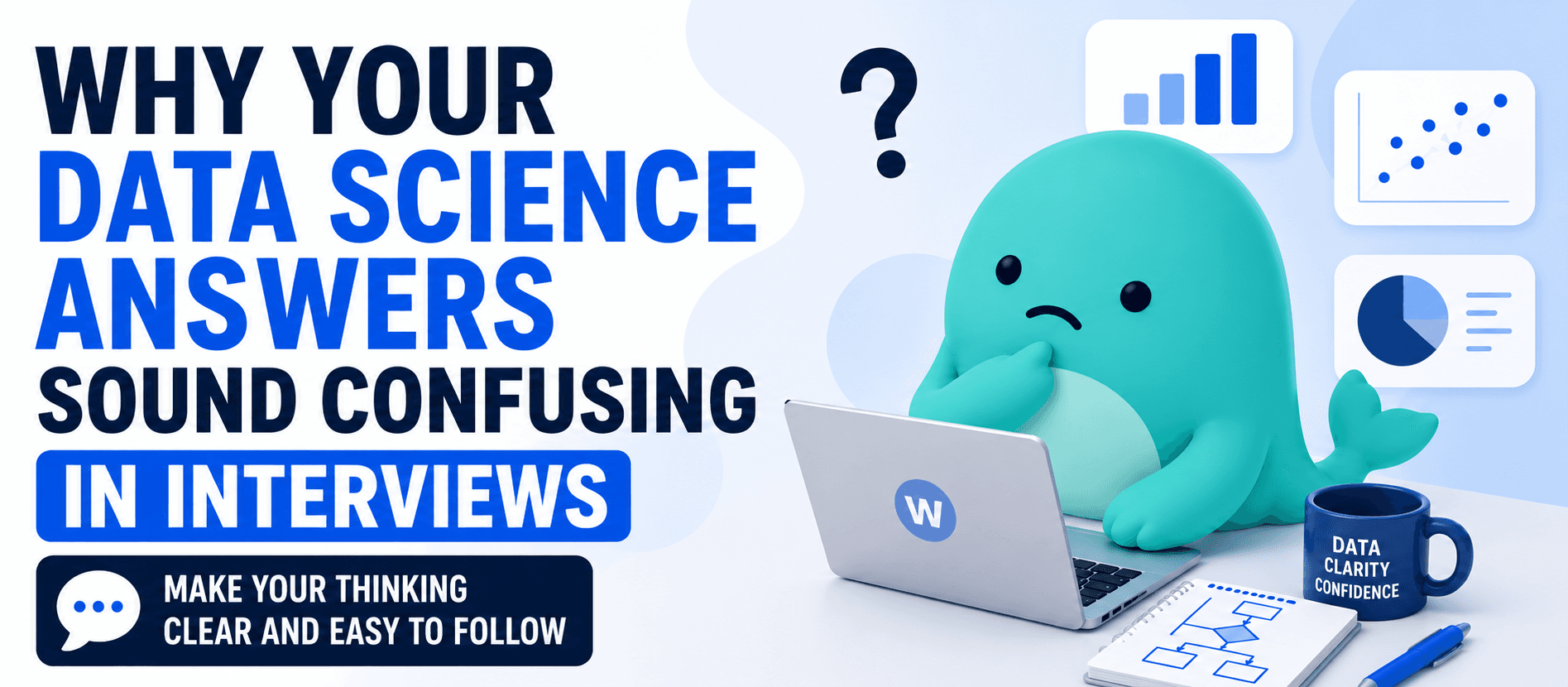
Most data science candidates assume interview communication problems come from weak English.
Usually, that's not the real issue.
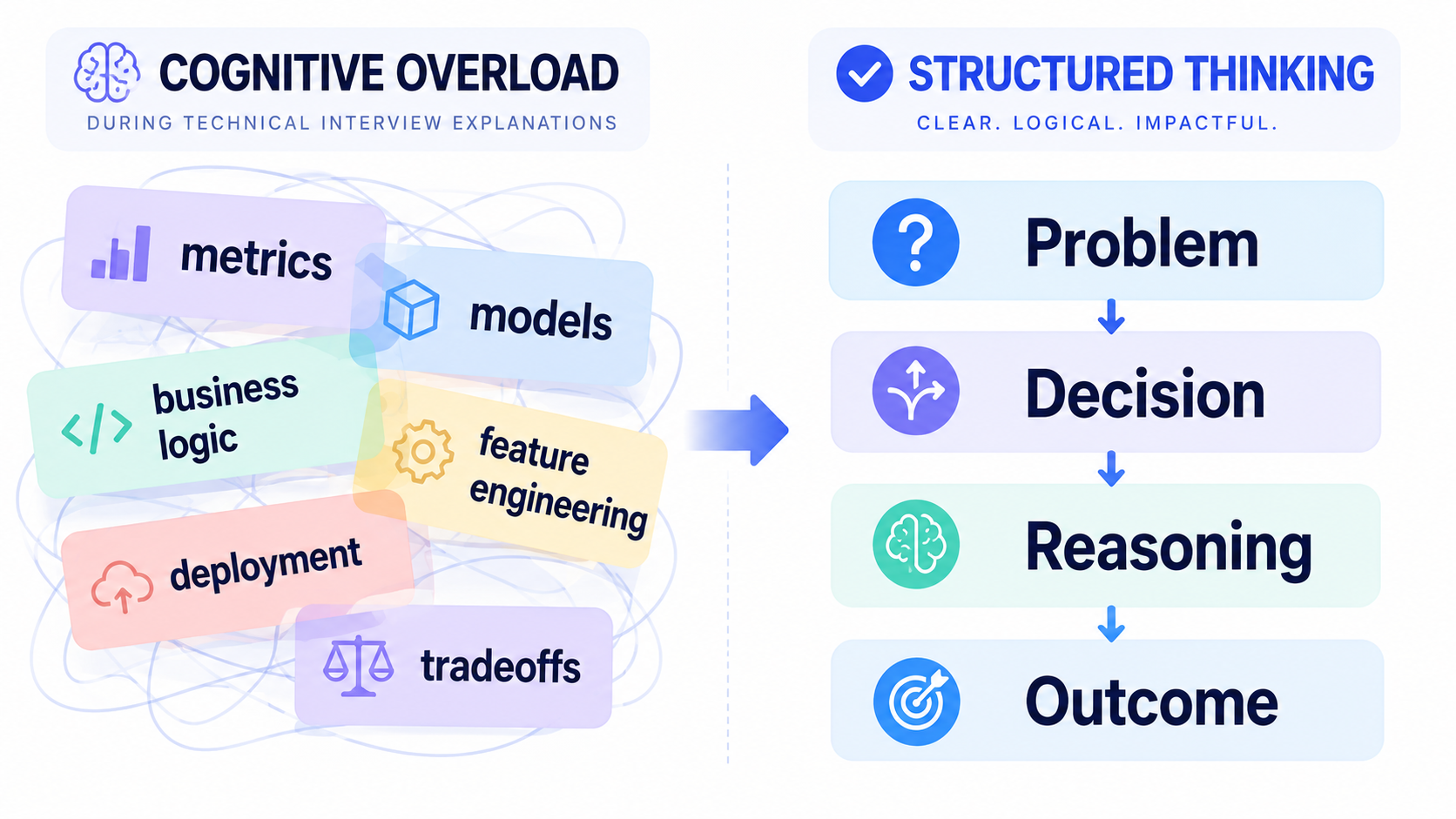
The bigger problem is cognitive overload.
You're trying to explain statistical reasoning, business logic, assumptions, edge cases, tradeoffs, and technical implementation — all while speaking in a second language under pressure. The result is often an answer that feels dense, fragmented, or difficult to follow even when the underlying knowledge is strong.
Interviewers rarely say:
“This candidate is smart, but difficult to follow.”
Instead, they say things like:
- “The explanation felt scattered.”
- “I couldn't fully understand the reasoning.”
- “The answer lacked structure.”
- “Communication could be clearer.”
For data scientists, this matters more than many people realize. Your job isn't just building models. It's explaining complex decisions clearly to people who often aren't deeply technical.
And interviews evaluate that skill directly.
Key insight: In data science interviews, clarity is often interpreted as competence. Confusion is often interpreted as uncertainty — even when your technical thinking is correct.
Why data science answers become hard to follow
The problem usually starts with compression.
Many candidates try to fit too much information into a single answer: model selection, feature engineering, evaluation metrics, experimentation logic, business impact, edge cases, deployment concerns — all inside one uninterrupted stream of speech.
The interviewer has no time to process the structure.
What sounds “complete” to the speaker often sounds overwhelming to the listener.
This becomes even worse in English because your working memory is already busy handling translation, sentence construction, and vocabulary retrieval simultaneously.
Strong communicators reduce cognitive load constantly.
Weak communicators accidentally increase it.
That's the difference.
The hidden mistake: answering everything at once
A common data science interview failure mode sounds like this:
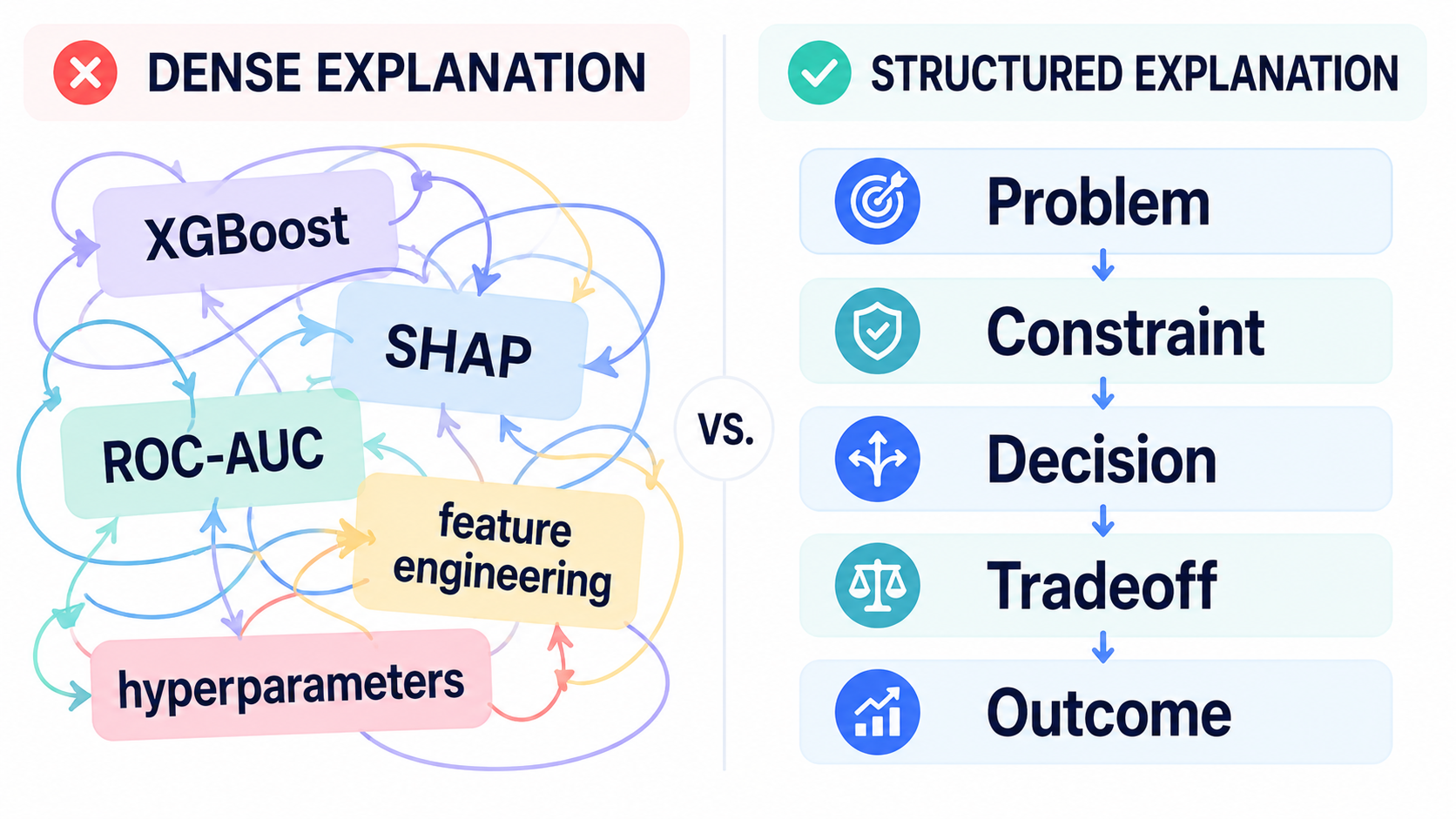
“So first I cleaned the data and handled missing values, then I tried XGBoost and random forest, then we checked precision and recall because the dataset was imbalanced, and after that we improved feature engineering and also looked at deployment constraints…”
Nothing in that answer is technically wrong.
But the listener doesn't know:
- what the main point is,
- which decision matters most,
- or where the explanation is going.
The answer feels like a moving train with no stations.
A better approach is surprisingly simple: separate reasoning into distinct layers.
For example:
- The problem
- The decision
- The reasoning behind the decision
- The outcome or tradeoff
Not because interviewers need rigid frameworks — but because humans process structured speech dramatically faster.
Strong candidates guide the listener step-by-step
One of the clearest differences between average and strong data scientists in interviews is pacing.
Strong candidates don't rush to prove how much they know.
They guide the listener through the thinking process gradually.
Instead of this:
“We used XGBoost because it outperformed the baseline after feature engineering and hyperparameter tuning.”
they often sound more like this:
“Initially we started with logistic regression as a baseline because interpretability mattered.”
“Later we tested tree-based models and found XGBoost performed significantly better on recall.”
“At that point we had to decide whether the performance gain justified the additional complexity.”
The second version feels calmer and easier to process because each sentence introduces only one new idea.
That's extremely important in spoken communication.
Your answer needs a narrative, not just information
A lot of data science answers fail because they sound like disconnected technical fragments.
Interviewers don't just want isolated facts. They want to understand your decision-making process.
That's why strong answers usually contain:
- context,
- prioritization,
- tradeoffs,
- and progression.
In other words: narrative.
Not storytelling in a dramatic sense — just logical movement from one idea to the next.
For example, compare these two styles.
Weak style:
“We used AUC, precision, recall, SHAP values, and feature importance.”
Stronger style:
“Because the dataset was imbalanced, recall became more important than overall accuracy. After selecting the model, we used SHAP values to explain the predictions to non-technical stakeholders.”
The second answer creates cause-and-effect relationships.
That's what makes explanations feel intelligent instead of fragmented.
Why interviewers interrupt confusing candidates more often
Many candidates assume interruptions mean the interviewer is aggressive or impatient.
Usually, interruptions happen because the interviewer is trying to recover clarity.
When explanations become too dense or nonlinear, interviewers start interrupting to:
- narrow the scope,
- reset the structure,
- clarify assumptions,
- or extract the missing conclusion.
This creates a stressful loop: the interruption increases anxiety, anxiety reduces structure, and the next answer becomes even harder to follow.
Strong structure prevents this spiral before it starts.
WhalePrep observation: Candidates who pause briefly between ideas are interrupted significantly less often than candidates who speak continuously without structural breaks.
One technique that immediately improves clarity
The fastest improvement most candidates can make is verbal signposting.
That simply means telling the interviewer where your answer is going.
For example:
- “There were two main reasons we chose that approach.”
- “I'd break the problem into three parts.”
- “The biggest tradeoff was between interpretability and performance.”
- “First I'll explain the business constraint, then the modeling decision.”
These phrases feel almost trivial.
But they massively reduce listener effort because the interviewer no longer has to guess the structure in real time.
Good communication often feels slower to the speaker and dramatically clearer to the listener.
The best data scientists sound simpler than expected
One surprising pattern in senior interviews: high-level candidates often sound less complicated, not more.
They use fewer unnecessary details. Fewer buzzwords. Fewer technology dumps.
Instead, they emphasize:
- decision quality,
- tradeoffs,
- prioritization,
- business impact,
- and communication clarity.
Junior candidates often try to prove intelligence through density.
Senior candidates usually prove intelligence through clarity.
You do not need perfect English to sound clear
This is one of the biggest misconceptions among non-native speakers.
Interviewers do not expect flawless grammar or accent neutrality.
What they care about much more is whether your thinking is easy to follow.
A candidate with imperfect English but strong structure often performs better than someone with advanced English who explains ideas chaotically.
Clarity comes more from organization than vocabulary sophistication.
That means: shorter sentences often help, slower pacing often helps, and cleaner transitions almost always help.
Simple language is not a weakness in technical interviews.
Confusing language is.
A rehearsal method that works better than silent preparation
Most data scientists prepare interviews by reading solutions or mentally rehearsing concepts.
That improves knowledge.
It does not automatically improve spoken clarity.
The real skill is translating technical reasoning into structured real-time communication.
A much more effective method: record yourself explaining one technical decision out loud.
Not the entire project. Just one decision.
For example:
- why you selected a metric,
- why you rejected a model,
- why recall mattered more than precision,
- why a feature engineering step improved performance.
Then listen back and ask:
- Did the explanation have a clear starting point?
- Did each sentence introduce only one idea?
- Did the listener always know why the decision was made?
- Did I sound structured or overloaded?
Most candidates notice problems immediately once they hear themselves externally.
And that's exactly why spoken interview practice matters so much.
Practical target: Aim to make your answers feel easy to process in real time. In interviews, clarity usually creates stronger impressions than maximum technical density.
The goal of a data science interview answer isn't to compress your entire knowledge graph into 90 seconds.
It's to make the interviewer feel:
“This person understands complex problems — and can explain them clearly enough to work with real teams.”
That's the skill strong data scientists consistently demonstrate.