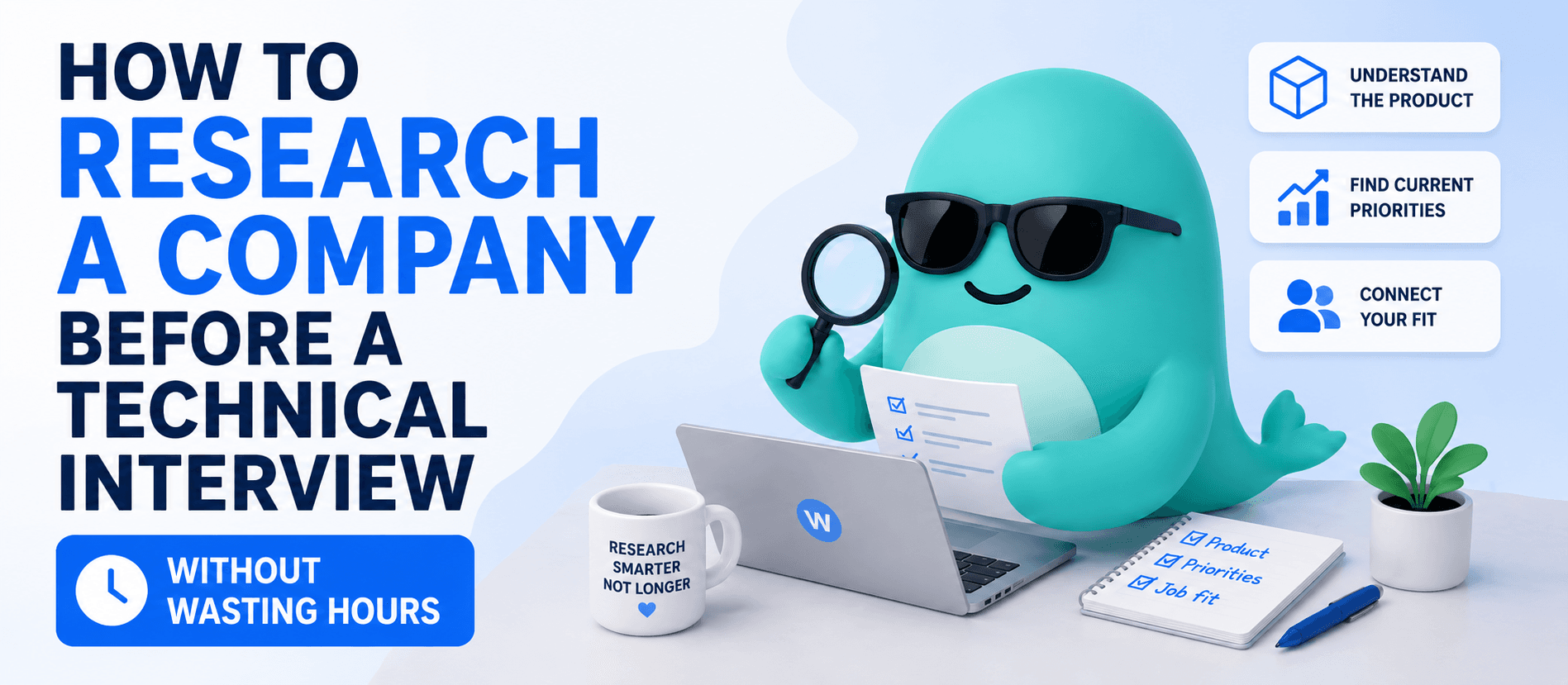
Most candidates approach company research the wrong way.
They open ten tabs. Read mission statements. Scroll through old LinkedIn posts. Dive into product pages they barely understand. Two hours later, they know more facts — but still can't answer the questions interviewers actually care about:
- Why this company?
- Why this role?
- What interests you about the product?
- What problems do you think we're solving?
In technical interviews, company research isn't about memorizing information. It's about building enough context to sound grounded, specific, and genuinely interested.
And the good news is: this usually takes less than an hour.
WhalePrep observation: Candidates who spend 30–45 focused minutes researching a company generally sound more credible than candidates who spend 3+ hours consuming random information without a framework.
What interviewers are actually looking for
Most interviewers are not testing whether you've "done your homework."
They're testing whether you can quickly understand a business environment — the same way you'd need to do on the job.
A strong candidate doesn't recite facts from the company website. They connect dots:
- what the company sells,
- who the users are,
- what probably matters internally,
- and how their own experience fits into that picture.
That's the signal.
A candidate saying:
“I saw your company recently expanded the analytics dashboard for enterprise teams. My last role also involved reducing reporting friction for larger customers, so that direction immediately stood out to me.”
sounds dramatically stronger than:
“I really admire your innovation and company culture.”
Even if both candidates prepared for the same amount of time.
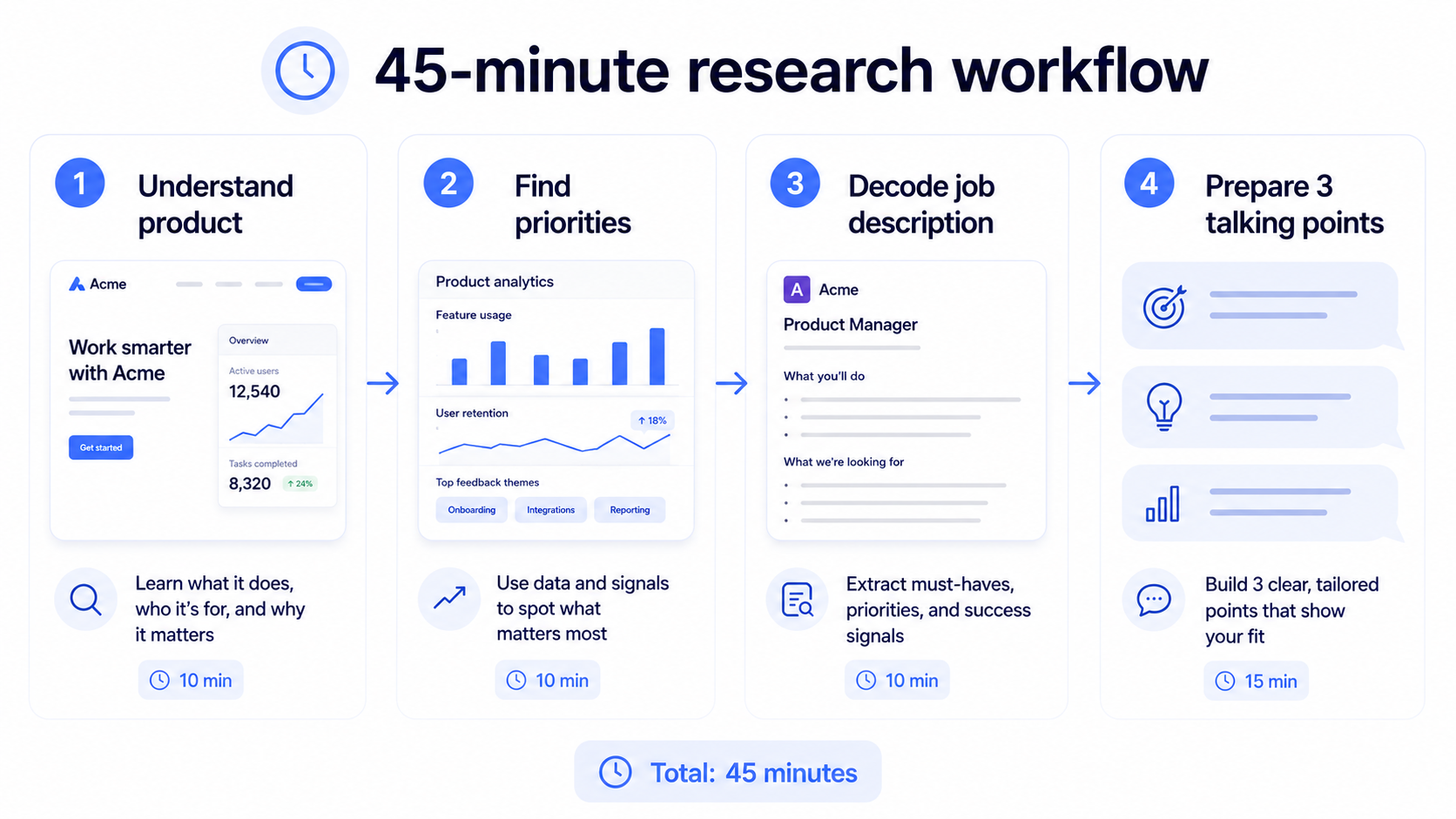
The 45-minute research framework
The goal is not to become an expert. The goal is to reduce uncertainty before the interview.
You only need to understand three things:
- What the company does
- What problems they likely care about
- Why your background overlaps with those problems
Everything else is optional.
Step 1: Understand the product in plain English
Start with the simplest possible question:
What does this company actually help people do?
Not the investor version. Not the marketing slogan. The plain-English version.
If you can't explain the product in one or two simple sentences, you probably don't understand it yet.
Good examples:
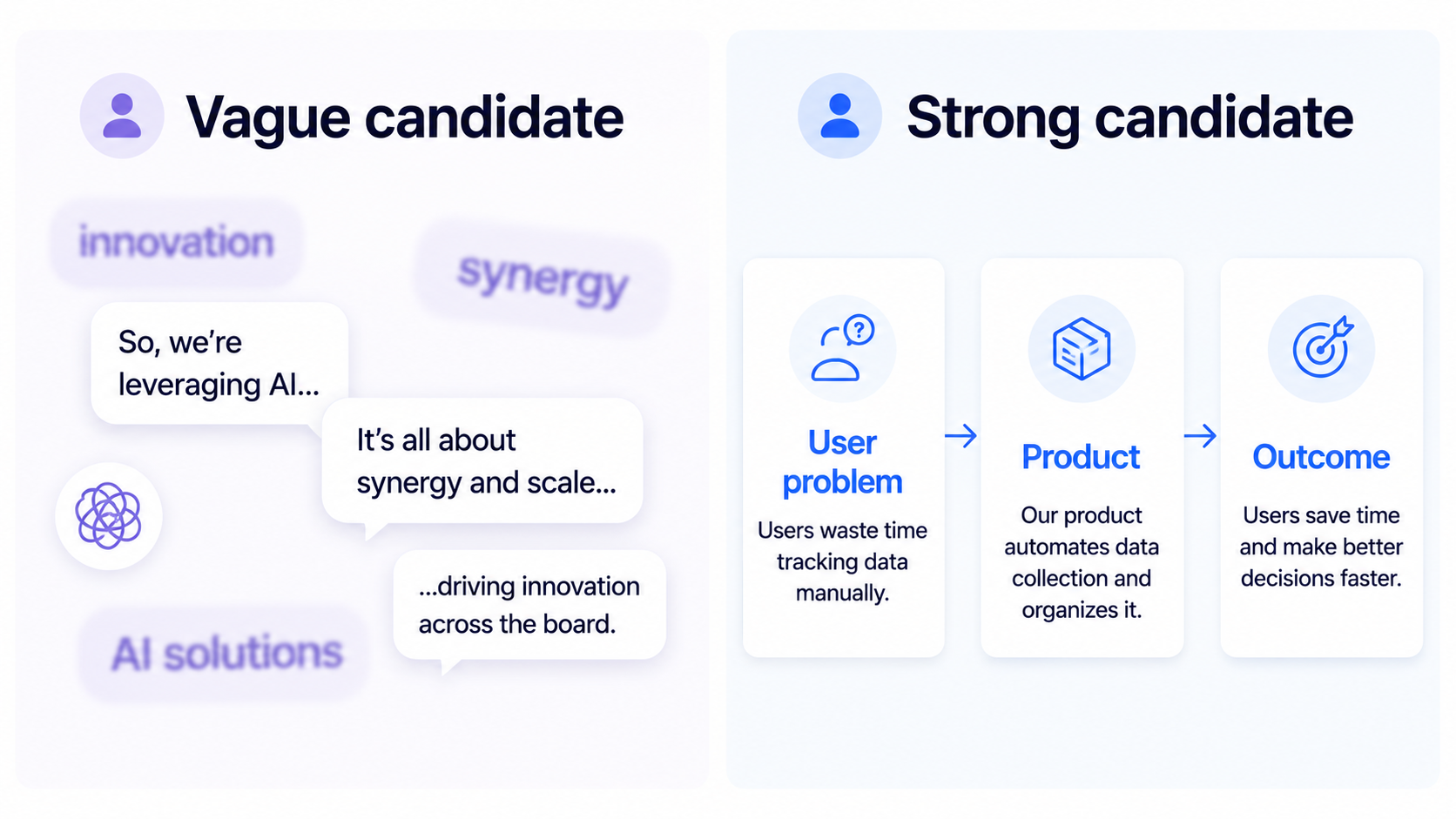
- “They help companies analyze customer support conversations.”
- “They make collaboration tools for designers.”
- “They're building software that helps recruiters screen candidates faster.”
Bad examples sound vague and corporate:
- “They empower digital transformation.”
- “They redefine productivity.”
- “They leverage AI-driven innovation.”
Those phrases are almost useless in interviews because they don't connect to real users or real problems.
Spend 10 minutes on:
- the homepage,
- product screenshots,
- pricing page,
- and maybe one demo video if available.
That's usually enough.
Step 2: Find the company's current priorities
This is where most candidates waste time.
You do not need to read five years of company history.
You need to identify what the company appears to care about right now.
Usually, the answer is surprisingly visible.
Look for signals like:
- recent product launches,
- engineering blog posts,
- hiring patterns,
- roadmap announcements,
- AI integrations,
- enterprise expansion,
- performance/scalability mentions,
- security/compliance focus,
- mobile redesigns,
- international growth.
The fastest source is often:
- the company blog,
- recent LinkedIn posts,
- release notes,
- or the careers page itself.
A backend-heavy hiring page mentioning scalability and distributed systems tells a very different story than a startup aggressively hiring designers and growth marketers.
Key insight: You are not researching the company for trivia. You're researching it for conversational leverage.
Once you identify a likely priority, your interview answers become easier to tailor naturally.
Instead of giving generic examples, you start emphasizing the parts of your experience that align with their current direction.
Step 3: Read the job description like a detective
Most candidates skim job descriptions. Strong candidates reverse-engineer them.
A job description is usually a compressed list of the team's current pain points.
If a QA role repeatedly mentions:
- regression testing,
- flaky automation,
- CI/CD,
- and cross-functional communication,
the team probably has reliability and release-process problems.
If a PM role emphasizes:
- prioritization,
- stakeholder management,
- analytics,
- and ambiguity,
the company is likely struggling with alignment or scaling product decisions.
You're not just reading requirements. You're identifying stress.
That changes how you answer questions.
Instead of trying to sound impressive in general, you start solving the problems they already hinted at.
Why this matters: Interviewers trust candidates faster when their examples feel relevant to the team's current reality.
Step 4: Prepare only 2–3 company-specific talking points
This is the part that creates the illusion of deep preparation.
You do not need ten thoughtful observations. You need two good ones.
For example:
- a recent product direction you genuinely found interesting,
- a technical challenge that overlaps with your experience,
- a company decision you can intelligently comment on,
- or a user problem you relate to personally.
That's enough to carry an entire interview conversation naturally.
The biggest mistake candidates make is trying to sound over-informed. It often backfires and feels rehearsed.
A concise, specific observation sounds much stronger than an information dump.
Compare:
“I noticed your mobile app reviews repeatedly mention onboarding friction for first-time users. I thought that was interesting because my previous team dealt with something very similar.”
vs.
“I researched your Series B funding, founder story, company values, Glassdoor reviews, tech stack history, and organizational structure.”
One sounds thoughtful. The other sounds anxious.
What technical candidates should focus on specifically
The deeper the technical role, the less interviewers care about polished corporate enthusiasm.
Engineers, analysts, and QA candidates are usually evaluated more on practical understanding than emotional excitement.
That means your research should focus on:
- product complexity,
- scale,
- users,
- workflows,
- technical constraints,
- and collaboration patterns.
Not inspirational branding language.
For example:
- A data platform company likely cares about reliability and trust.
- A B2C mobile app likely cares about retention and UX friction.
- A developer tools company probably values clarity and technical depth.
Even spending five minutes thinking through those implications helps your answers feel dramatically more grounded.
The biggest research mistake: trying to memorize everything
Interview stress destroys memory.
This is especially true in English interviews, where your brain is already handling translation, pacing, grammar, and answer structure simultaneously.
Candidates who try to memorize large amounts of company information often freeze under pressure and forget most of it anyway.
The better strategy is lighter and more flexible: understand the company at a high level, prepare a few anchor points, and stay conversational.
That sounds more authentic — because it is.
How to sound informed without sounding scripted
The strongest interview answers usually reference company context briefly — not constantly.
A small mention is enough.
For example:
- “That reminded me of your recent mobile redesign.”
- “It sounds similar to the scalability challenges your team mentioned.”
- “I noticed your company is expanding into enterprise customers.”
Short references signal awareness without hijacking the conversation.
What interviewers want is not a researcher. They want someone who can quickly orient themselves inside a business environment and communicate clearly about it.
That's a very different skill.
A practical preparation routine that actually works
The night before the interview:
- spend 30–45 minutes researching,
- write down 3 observations,
- prepare 2 questions for the interviewer,
- and stop.
Do not spiral into endless preparation.
Most candidates hit diminishing returns surprisingly fast. After a certain point, extra research mainly increases anxiety — not performance.
The goal is confidence and clarity, not total information coverage.
Practical target: Be able to explain what the company does, what they likely care about right now, and why your experience overlaps with that — naturally, in under 90 seconds.