You have done the work. You have spent years mastering your craft. You know exactly what separates a mediocre product strategy from a market-defining one. You can identify the edge cases in a QA testing pipeline at a glance, and you can explain the nuances of a complex Data Science model to stakeholders in your sleep.
In your native language, you are an expert. You are articulate, persuasive, and sharp.
But then you step into an English-speaking interview. The hiring manager asks a seemingly straightforward behavioral question. Suddenly, your mind goes blank. The sophisticated concepts you handle daily feel trapped behind a thick wall. You find yourself using simplistic vocabulary, rambling without a clear point, and filling the silence with an agonizing number of "ums" and "uhs."
You walk out of the interview knowing you sounded like a junior, despite having years of advanced experience.
This is the most frustrating paradox in global tech hiring: incredibly smart, highly capable candidates fail interviews not because they lack the technical skills, but because their cognitive bandwidth collapses under the pressure of real-time translation.
Understanding why this happens is the first step to ensuring it never happens to you again.
The invisible weight of translation drag
When you speak your native language, the process is practically automatic. Your brain's prefrontal cortex is entirely dedicated to the content of your message. You are accessing deep professional memories, structuring a compelling narrative, and simultaneously reading the interviewer's micro-expressions to gauge their reaction.
Speaking a second language under pressure completely shatters this allocation of mental resources.
Instead of focusing 100% on what you are saying, your brain is forced to run a massive, energy-draining background process just to figure out how to say it. You are retrieving vocabulary, second-guessing your grammar, monitoring your pronunciation, and translating concepts on the fly.
This phenomenon is known as translation drag. It eats up your working memory, leaving very little cognitive RAM available for actual problem-solving or narrative structure.
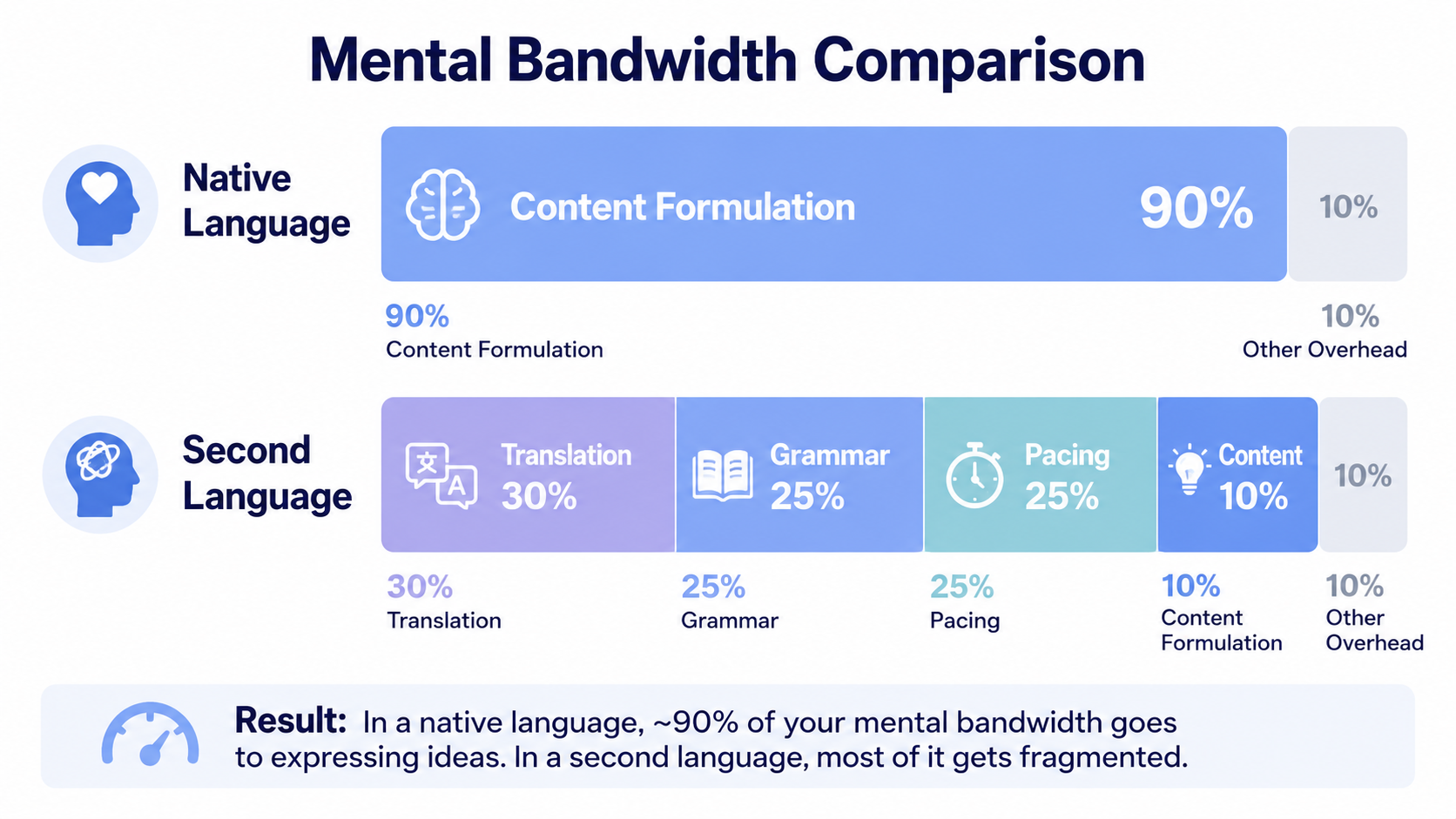
When your cognitive bandwidth maxes out, something has to give. Usually, it is your narrative structure and your professional nuance. You stop telling a compelling story about how you resolved a critical production bug, and instead, you just list out technical steps mechanically because that is all your brain can handle in English.
The three failure modes of translation drag
When translation drag overwhelms a candidate, the breakdown usually manifests in one of three highly predictable ways. Interviewers see these patterns all the time, though they rarely understand the linguistic psychology behind them.
The first is the Data Dump. In an attempt to prove they know the answer, the candidate overcompensates for their lack of precise English vocabulary by throwing every possible piece of information at the interviewer. If a PM is asked about prioritization, instead of giving a crisp, structured framework, they talk continuously for four minutes, hoping that somewhere in that wall of words, the right answer exists. It is exhausting for the listener and signals a lack of clarity.
The second is the Under-share. This is the exact opposite of the dump. The candidate realizes they do not have the vocabulary to explain the nuance of a situation, so they give up halfway through the thought. They provide painfully brief, one-sentence answers to complex behavioral questions. To the interviewer, this doesn't look like a language barrier; it looks like a lack of experience or a lack of depth.
The third, and perhaps most stressful, is the Spiral. This happens when you start a sentence in English, realize halfway through that you don't know how to finish it grammatically, and panic. You try to pivot, lose your original train of thought entirely, and end up concluding the answer with a nervous, "So... yeah. That's it."
Key insight: Interviewers are human, and humans are highly susceptible to the halo effect. When an answer is delivered with hesitation, poor pacing, and excessive filler words, the interviewer unconsciously downgrades the perceived intelligence and technical competence of the candidate. They conflate how you speak with how well you think.
The "Advanced" level paradox
There is a cruel irony in English interviews: they are often much harder for senior candidates than they are for juniors.
If you are a junior developer, the concepts you need to explain are relatively straightforward. You describe your tech stack, you talk about a basic project, and the vocabulary required is highly standardized.
But if you are interviewing for an Advanced or Expert-level role, the entire interview is based on nuance. You aren't just explaining what you did; you are explaining why you did it, the trade-offs you considered, the stakeholder politics you navigated, and the strategic vision you hold.
Nuance requires precise vocabulary. When you lack that precision, you are forced to use blunt, simplistic English to describe complex, sophisticated ideas. This creates a severe mismatch between your actual seniority and how you sound in the room. A highly experienced QA Lead might sound like a mid-level tester simply because they lack the transitional phrases needed to articulate advanced risk-mitigation strategies.
The false comfort of the written script
When smart candidates realize they have a communication problem, they usually try to solve it with the wrong tool: writing.
They open a Google Doc and start writing out scripts for every possible interview question. They write beautiful, grammatically perfect answers. They read them over and over until they feel prepared.
This is a trap.
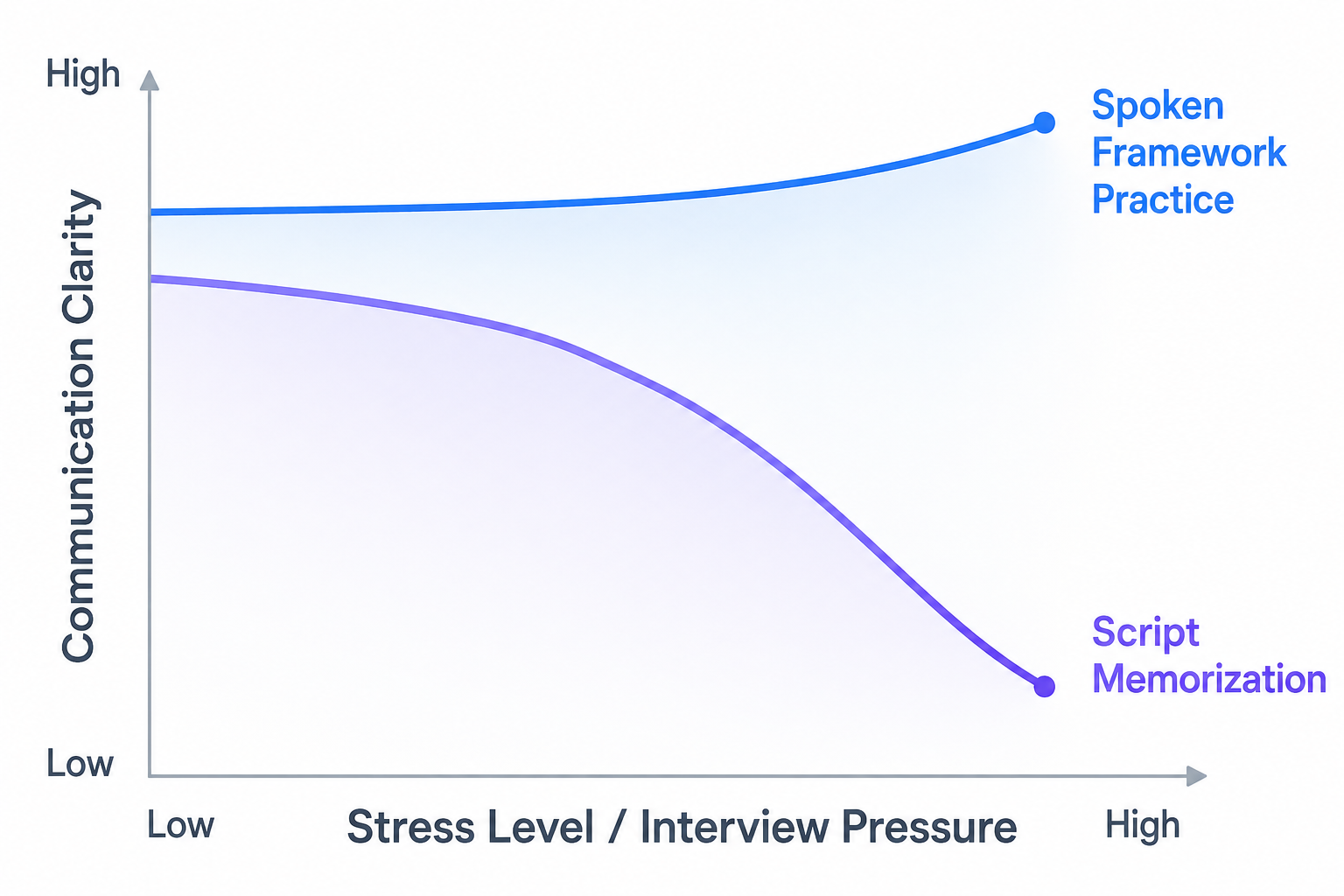
Written English and spoken English utilize entirely different neural pathways. Writing is a visual-motor task that allows for infinite pausing, editing, and backspacing. Speaking is an auditory-vocal task that happens in real-time with zero room for latency.
When you memorize a written script, you are not actually practicing speaking. You are practicing reading from your own memory. The moment the interviewer asks a question that slightly deviates from your script, the illusion shatters. You can't find your place in the mental document, the translation drag hits you all at once, and the panic sets in.
Decoupling language from expertise
To pass high-level English interviews, you must reduce the cognitive load of speaking. You cannot learn perfect English in two weeks, but you can drastically reduce translation drag by building muscle memory for structure.
You need to decouple your technical expertise from the mechanics of delivering it.
Think of your interview answer as a house. Your technical knowledge—the bugs you fixed, the products you launched, the data you analyzed—is the furniture. The English language is the architecture: the walls, the floors, the hallways.
Right now, you are trying to build the house and arrange the furniture at the exact same time, while the interviewer watches. It is overwhelming.
The solution is to build the architecture in advance. You do this by internalizing structural frameworks and transition phrases so deeply that you don't even have to think about them. If you automatically know how to start an answer ("There are three main factors I considered..."), how to transition between points ("Moving on to the second phase..."), and how to conclude cleanly ("Ultimately, this resulted in..."), you no longer have to translate those parts of your speech.
Your brain can suddenly relax. The architecture is standing on its own. Now, you have massive amounts of free mental RAM to simply focus on placing the furniture—your actual technical expertise.
Getting comfortable with deliberate silence
One of the most profound shifts you can make in your delivery is changing your relationship with silence.
In a second language, silence feels terrifying. When your brain pauses to search for a word, it feels like an eternity. To fill that terrifying void, candidates use filler words: um, uh, like, you know, basically. But filler words are a sign of cognitive overload. They signal to the listener that you are struggling.
You must learn to replace the filler word with a deliberate, physical pause. When you need to find a word, simply close your mouth. A two-second pause feels like a failure to the speaker, but to the listener, it registers as thoughtfulness. It looks like you are carefully considering your brilliant answer.
Practical target: Do not practice by writing. Practice by speaking out loud. Record yourself answering a question for 90 seconds. Do not stop if you make a mistake. Force your brain to navigate the translation drag in real-time, and deliberately replace your filler words with silent pauses. Doing this for just 10 minutes a day will physically rewire your speaking habits.
English interviews do not test your fundamental intelligence, and they do not perfectly test your technical ceiling. They test your ability to manage cognitive load under pressure. By understanding translation drag, abandoning written scripts, and building structural muscle memory, you can remove the linguistic friction and let your actual expertise command the room.