Interview prep is supposed to make you feel more ready. Too often, it does the opposite: you start with good intentions, then end up cramming late at night, replaying every weak answer in your head, and treating practice like a punishment.
That is usually where burnout begins. Not with one big collapse, but with a prep routine that asks too much, too often, and gives you no clear sense of progress.
The goal is not to practice less forever. The goal is to practice in a way your energy can actually sustain — long enough to improve, but light enough that you do not start dreading the next session.
Key insight: Interview practice should leave a small amount of energy in the tank. When every session feels like a test, your brain starts defending itself instead of learning.
Why interview prep burns people out
Burnout in interview prep usually comes from three things at once: uncertainty, repetition without feedback, and emotional overinvestment. You do not just need to speak English. You need to sound structured, confident, relevant, and calm — often while thinking quickly under pressure.
That is a lot to carry in one session. If you keep pushing through long practice blocks, the output may look productive, but the learning often gets worse. You repeat the same answers, make the same mistakes, and end the day feeling like you worked hard without moving forward.
The hidden problem is that many people practice as if more intensity automatically means more progress. In reality, interview skills respond better to consistency than to drama.
Build a practice routine you can repeat tomorrow
A sustainable routine starts small on purpose. That sounds almost too simple, but it is usually the difference between steady improvement and a short burst followed by avoidance.
Choose a session length you can repeat on a bad day, not just on an optimistic one. For many candidates, 10–20 minutes is enough. That window is long enough to answer several questions, notice patterns, and make one meaningful adjustment without crossing into fatigue.
The session should have a single focus. Not “improve everything.” One day it may be pacing. Another day it may be structure. Another day it may be reducing filler words. The smaller the target, the easier it is to finish the session feeling successful.
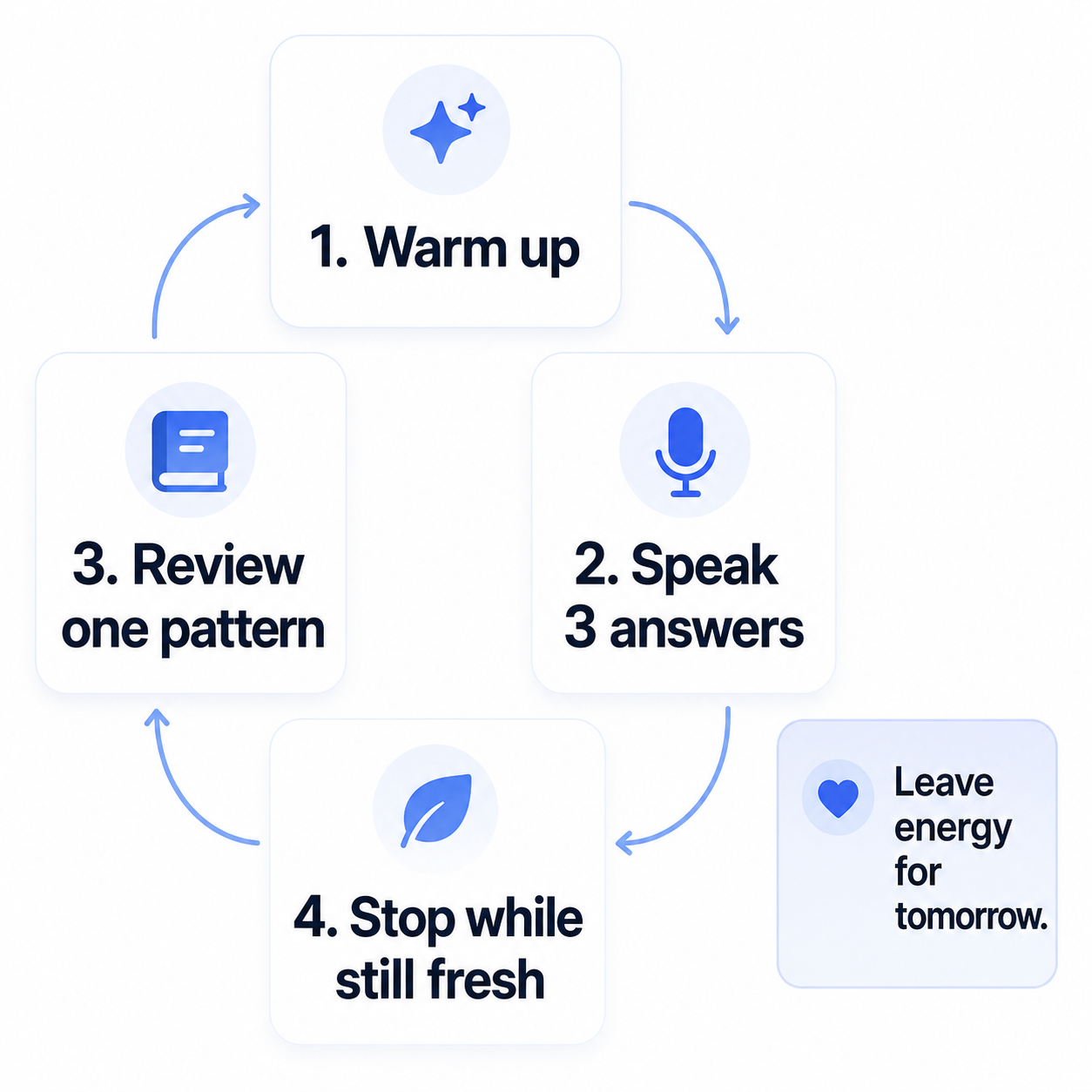
If you want a practical rhythm, try this mental split: one short warm-up, one main speaking block, one quick review. That is enough to build momentum without needing a heroic level of discipline.
Practical target: Finish each practice session with one thing you would repeat, and one thing you would change next time. That keeps the routine honest without turning it into self-criticism.
Stop treating every answer like a performance
One of the fastest ways to burn out is to turn each answer into a performance review. You start aiming for perfect wording, perfect fluency, perfect structure, perfect confidence. That level of pressure makes even a normal practice session feel emotionally expensive.
A better frame is to think in reps, not verdicts. One answer is not your level. It is just one rep. Some reps will be cleaner than others. Some will sound awkward. Some will show that you know the content but lose the thread halfway through. That is normal.
This mindset matters especially in English interviews, because speaking a second language already adds load. You are translating, selecting vocabulary, remembering examples, and trying to stay composed at the same time. If you pile perfectionism on top of that, the session stops being training and starts becoming stress rehearsal.
A lighter approach is to define success before you begin. For example: today I will answer four questions out loud and keep my pace steady. Or: today I will pause instead of filling silence. Or: today I will practice only the opening sentence of each answer. Clear success criteria reduce the emotional noise.
Use feedback that helps you recover, not spiral
Feedback is useful only when it gives you a next move. If it only tells you what went wrong, it can become another source of fatigue.
The best feedback is narrow and actionable. It should point to one pattern, not ten. Maybe you talk too fast when you are unsure. Maybe your answers become too long when the question is broad. Maybe you use filler words when switching between ideas. Once you can name the pattern, you can work on it without feeling overwhelmed.
This is also where a lot of candidates make an avoidable mistake: they review their practice in a harsh, global way. “I sounded bad.” “My English is weak.” “I am not ready.” Those statements feel emotionally true in the moment, but they are too vague to improve anything.
Try replacing them with a more precise sentence. “I lost structure after the first point.” “I rushed the opening.” “I needed a pause before the second example.” Precision makes recovery possible.
Leave space between sessions
Progress does not come only from speaking. It also comes from letting your brain settle.
If you practice hard every day without any variation, your sessions start to blur together. The answers feel familiar, but the learning no longer feels fresh. A little spacing helps more than people expect. It gives your brain time to sort out what it heard and make the next session more useful.
That does not mean you need long breaks or a complicated schedule. It just means you should avoid the trap of endless repetition in one sitting. A smaller, cleaner session today is usually better than a long one that leaves you mentally flat tomorrow.
This is especially important right before an interview. In the final stretch, the goal is not to reinvent your preparation. It is to keep your voice warm, your structure stable, and your energy protected.
A calmer way to prepare before the interview
In the last few days before an interview, shift from expansion to maintenance. Do not keep adding new frameworks, new vocabulary lists, and new answer variants unless you truly need them. At that point, too much input can make you feel less ready, not more.
Instead, rehearse the answers that matter most. Practice the opening to your self-introduction. Review two or three common questions. Say the answers aloud. Notice where you hesitate. Make the delivery simpler, not heavier.
This is often the moment when people overprepare because they are nervous. But nervousness usually wants certainty, and certainty is not always available. What you can build is familiarity. Familiarity lowers friction.
A good final session should feel almost underwhelming. That is a positive sign. It means you are no longer forcing the material. You are just keeping it alive.
The sustainable version of progress
The most effective interview prep is rarely the most intense one. It is the one you can repeat without resenting it.
That usually means shorter sessions, narrower goals, specific feedback, and enough rest to let the learning stick. It means measuring progress by clarity and confidence, not by how exhausted you feel after practice.
If you can finish a session and still feel capable of doing one more tomorrow, that is a very good sign. You are building a habit instead of a sprint.
Practical target: Aim for practice that feels steady, slightly challenging, and repeatable. That is the zone where improvement compounds without burning you out.