You are thirty minutes into your technical interview. You’ve successfully navigated the warm-up questions, discussed your testing philosophy, and walked through your approach to test case design. The interviewer leans back, smiles slightly, and asks the inevitable question:
"Tell me about a complex bug you found recently. How did you report it?"
For many QA candidates, this feels like an invitation to showcase their technical brilliance. They dive into a convoluted story about a rare race condition, a desynchronized cache, or an obscure database lock. They want to prove how clever they are at breaking software.
But interviewers aren’t usually looking for technical brilliance in this specific moment. They are looking for clarity.
In the daily reality of product development, finding a bug is only the first ten percent of the job. The remaining ninety percent involves documenting that bug, explaining it to a developer who is already overwhelmed with tasks, justifying its priority to a Product Manager, and ensuring it gets fixed without causing unnecessary friction.
When you answer this interview question, the hiring manager is quietly simulating what it will be like to work with you on a stressful Tuesday afternoon right before a major release. If your verbal explanation is scattered, missing key details, or overly emotional, the interviewer will naturally assume your written Jira tickets suffer from the exact same problems.
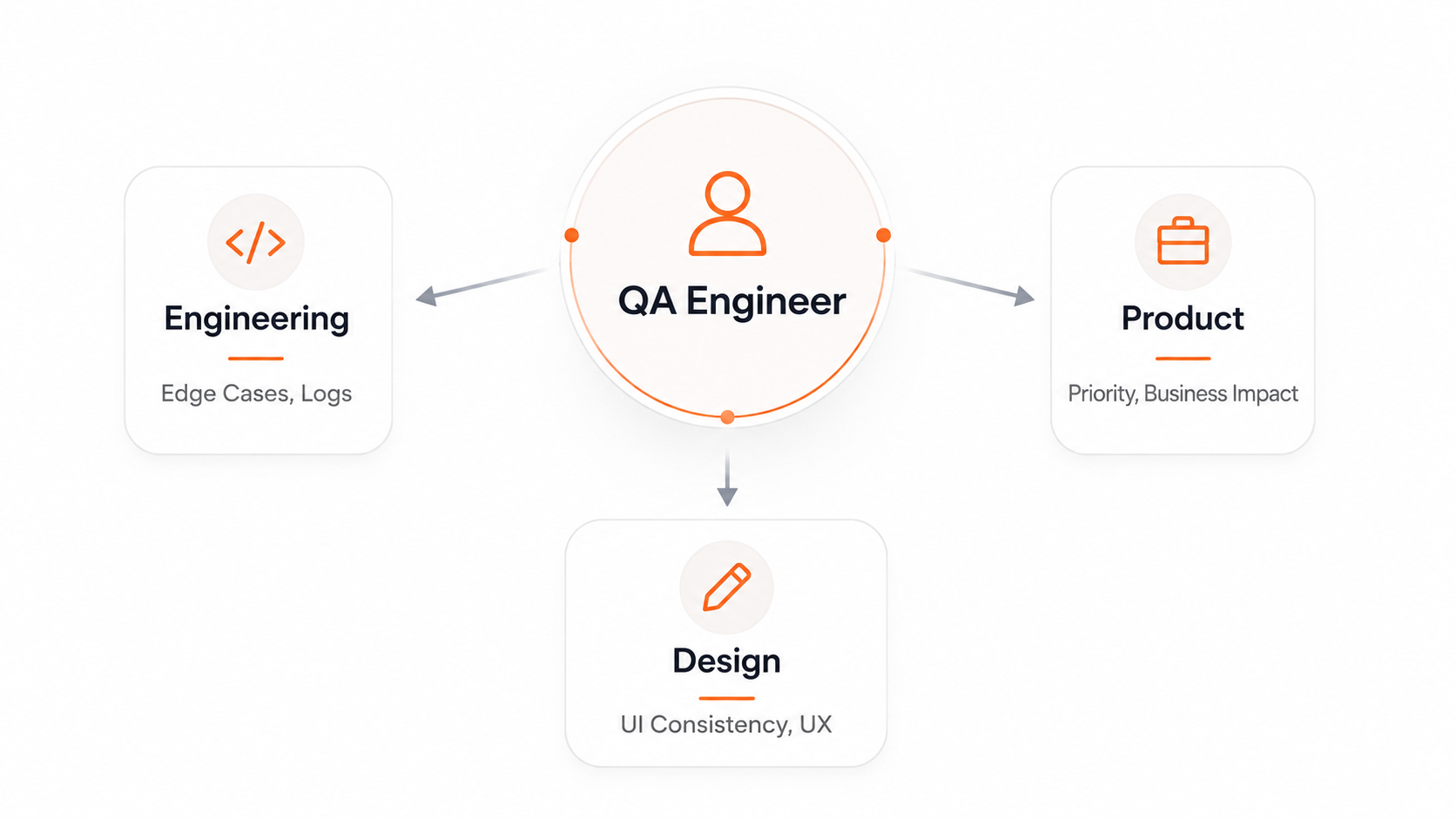
This is especially critical if you are interviewing for Advanced or Expert-level QA positions. At those levels, you are no longer just a tester; you are a communication bridge between engineering, product, and design.
Explaining a bug verbally is a distinct skill. It requires translating complex, non-linear technical investigations into a linear, easily digestible narrative. This guide breaks down the exact psychological framework and structural pacing you need to turn a messy bug into a perfect interview answer.
The cognitive load of the listener
To understand why most bug explanations fail in interviews, you have to understand the cognitive state of your interviewer.
When you start talking about a bug from your past, you already have the entire mental model of that software in your head. You know the architecture, you know what the UI looks like, and you know the business logic.
The interviewer has none of this. They are sitting in a dark room, metaphorically speaking, waiting for you to turn on the lights.
If you immediately start talking about a broken "Submit" button and a database error, the interviewer's brain has to frantically try to build the surrounding architecture out of thin air. Is this a web app? A mobile app? Is the user logged in? What are they trying to submit? This creates a massive cognitive load. Instead of listening to your brilliant deduction skills, the interviewer is expending all their mental energy just trying to figure out what application you are talking about. When an interviewer has to work hard to understand you, they subconsciously label you as a poor communicator.
Phase 1: Constructing the mental sandbox
The most powerful thing you can do when answering this question is to spend your first few sentences strictly building the context. You must construct the "mental sandbox" before you invite the interviewer to play in it.
Consider this weak opening, which is how roughly seventy percent of candidates start their answers:
"So, there was this bug where the discount applied twice, and the cart total went negative, which caused a huge crash in the backend."
It sounds dramatic, but it lacks grounding. Now look at a strong, senior-level opening:
"I was testing the mobile e-commerce checkout flow on iOS. I was logged in as a returning user with a saved credit card, and I was looking specifically at how the system handled expired promotional codes."
Notice the difference. The second example doesn't even mention a bug yet. But in two sentences, it has completely oriented the listener. The interviewer now knows:
- The platform (iOS).
- The feature area (Mobile checkout).
- The user state (Logged in, returning, saved payment).
- The intention of the test (Promo code validation).
When you build the sandbox first, every technical detail you provide afterward has a place to land in the listener's mind.

Phase 2: The mechanical sequence
Once the environment is established, your tone and pacing need to shift. You are transitioning from the setup to the execution.
Many candidates treat the reproduction steps like a mystery novel. They talk about what they "suspected," what they "clicked around on," and what they "eventually noticed." They add emotional color to the testing process.
In a professional QA environment, developers do not want emotional color. They want reproducible mechanics. If a developer cannot reproduce your bug, the bug essentially does not exist.
During the interview, your description of the reproduction steps should sound almost robotic in its precision. You are verbally guiding a blindfolded person through a room.
Instead of saying: "I tried adding a few different items and messing with the network connection to see if it would break the cart."
Say this: "The steps to reproduce were strictly sequential. First, add two items to the cart. Second, proceed to the payment screen. Third, throttle the network connection to simulate 3G speeds. Finally, tap the 'Pay' button exactly twice in rapid succession."
This mechanical delivery does something profound to the interviewer's perception of you. It signals that you do not rely on luck to find bugs. It shows that you isolate variables, document precise states, and understand the difference between random clicking and systematic stress testing.
In QA interviews, "boring and predictable" reads as highly competent.
Phase 3: Defining the reality gap
This is the most critical structural pivot in your explanation, and it is where the majority of candidates lose their clarity under pressure.
A bug is not simply a broken piece of code. Conceptually, a bug is the delta between what the software should do and what it actually does. If you only describe the broken state, you are forcing the interviewer to guess what the correct state was supposed to be.
Key insight: Advanced QA engineers never assume the expected behavior is obvious. They state it explicitly to prove their deep understanding of the product requirements.
Use the explicit phrases "Expected result" and "Actual result" in your spoken answer. These phrases act as verbal signposts. They immediately tell the interviewer that your brain naturally organizes information into standard, professional reporting formats.
Imagine you are describing an issue with a password reset flow.
The weak approach: "When the user clicked the reset link, it just took them to a blank page and threw a 500 error." The strong approach: "The expected result was that the user should be redirected to the 'Create New Password' screen, and the old token should be invalidated. The actual result was that the application threw a 500 internal server error, but the old token remained active, leaving a temporary security vulnerability."
The strong approach doesn't just describe a broken screen. It proves that the candidate understands the underlying business logic and security implications. It shows that you read the documentation, not just the UI.
Phase 4: Articulating the business impact
Junior testers stop talking once they have described the technical failure. They believe their job is done once the bug is isolated.
Senior and Advanced QA engineers understand that their job is risk management. Engineering teams have finite resources, and they cannot fix every bug before a release. Prioritization is everything. Therefore, a bug report is incomplete until it explains why the team should care enough to fix it immediately.
When an interviewer asks you to describe a bug, they are secretly waiting to see if you will bring up the impact on your own, without being prompted.
You need to connect the technical failure to a business reality. Think about the bug in terms of:
- Revenue friction: Does this prevent users from giving us money?
- Data integrity: Are we corrupting user profiles or analytics?
- User trust: Will this make the customer feel like our product is a scam or low-quality?
- Security: Are we exposing sensitive data?
Let's return to the mobile checkout bug.
Instead of concluding with, "So yeah, the checkout was completely broken," you elevate the conversation:
"Because this issue occurred on the main payment path for returning users, it constituted a high severity issue. It blocked our most loyal segment from completing purchases, which directly impacted daily conversion rates. I flagged it to the PM immediately as a release blocker."
This demonstrates product maturity. It shows you speak the language of Product Managers, not just the language of automation frameworks.
Navigating the inevitable follow-up questions
If you explain the bug well, the interviewer will likely poke at it. They want to see how you think on your feet and whether you actually understood the bug you just described.
A common follow-up is: "How did you investigate the root cause before handing it over to the developer?"
Interviewers are looking for your boundaries here. They want to see if you take initiative, but they also want to ensure you don't waste three days trying to do a backend developer's job.
A strong answer outlines a quick, logical isolation process:
- Platform isolation: "First, I checked if it was reproducible on Android and Web to isolate if it was an iOS-specific client issue or a backend API issue."
- Network inspection: "I opened Charles Proxy to intercept the payload and saw that the client was sending the correct promo code string, but the backend was returning a 400 Bad Request."
- Log checking: "I quickly checked DataDog for any server-side exceptions tied to my user ID during that timestamp."
By explaining this, you show that you hand developers highly enriched tickets, saving them hours of preliminary investigation.
Vocal delivery and managing translation drag
Even the most perfectly structured answer will fail if the delivery is erratic. For non-native English speakers, the cognitive load of translating technical flows can severely impact pacing.
When your brain is searching for the correct English term for "asynchronous behavior," your mouth will instinctively fill the silence with "um," "uh," or "basically." Furthermore, nervous candidates tend to speak faster, believing that speed equals fluency. In reality, speed removes the necessary buffer your brain needs to construct the next sentence.
The solution is not to memorize a script. The solution is deliberate pacing and the strategic use of silence.
Key insight: Silence feels exponentially longer to the person speaking than it does to the person listening. A two-second pause might feel agonizing to you, but to an interviewer, it registers as calm, thoughtful composure.
Slow down your baseline speaking rate. When you finish describing the "Context," stop. Close your mouth. Take a silent breath. Then begin the "Steps to Reproduce."
These micro-pauses serve two functions. First, they give your brain a millisecond to prepare the vocabulary for the next section. Second, they give the interviewer's brain time to process and visualize the information you just gave them.
Tying it all together
Answering the "explain a bug" question is not about proving you found the most obscure defect in the history of software. It is an audition for daily collaboration.
A strong answer removes friction. It builds the mental environment first. It delivers mechanical, repeatable steps. It clearly defines the gap between expectation and reality. And finally, it translates the technical failure into a business priority.
When you can do this consistently, you stop sounding like a junior tester who simply breaks things, and you start sounding like an Advanced QA professional who helps engineering teams ship better software.
The bug report is one of about twenty questions that recur across QA loops. The full set, grouped by what each one is really checking, is here: QA Engineer Interview Questions.
Practical target: Do not wait until the interview to try this format. Write down three complex bugs you have found in the last year. For each one, practice speaking the explanation out loud using the four phases: Context, Steps, Expected/Actual, and Impact. Force yourself to keep the entire explanation under 90 seconds.