“Tell me about yourself” sounds simple. But for many QA engineers — especially in English interviews — it's the question that immediately destabilizes the conversation.
Some candidates start listing every tool they've ever used. Others jump into their entire career history. Some speak too generally and never explain what kind of QA work they actually do. And many non-native speakers begin confidently, then lose structure halfway through the answer.
The problem usually isn't English level. It's lack of narrative structure.
A strong QA introduction does three things at once:
- explains your background,
- positions your strengths,
- and makes the interviewer feel like talking to you will be easy.
That's the real goal.
Important: Interviewers are not evaluating whether your life story is impressive. They're evaluating whether you can communicate clearly, stay relevant, and explain technical work without creating confusion.
Why this question matters more than most QA engineers think
The first answer in an interview sets the communication baseline for everything that follows.
If your introduction feels scattered, interviewers unconsciously expect future answers to be scattered too. If your explanation feels calm and structured, they assume your bug reports, test cases, and collaboration style are probably structured as well.
For QA engineers specifically, this matters a lot. The role is deeply communication-heavy. You're constantly translating technical observations into something understandable for developers, product managers, designers, and stakeholders.
That means your interview communication becomes part of the skill evaluation itself.
A strong answer doesn't sound memorized. It sounds organized.
The mistake most QA candidates make
Most weak answers fail in one of three ways.
Some candidates give a chronological autobiography: “I started in support, then moved to testing, then worked at Company X, then Company Y…”
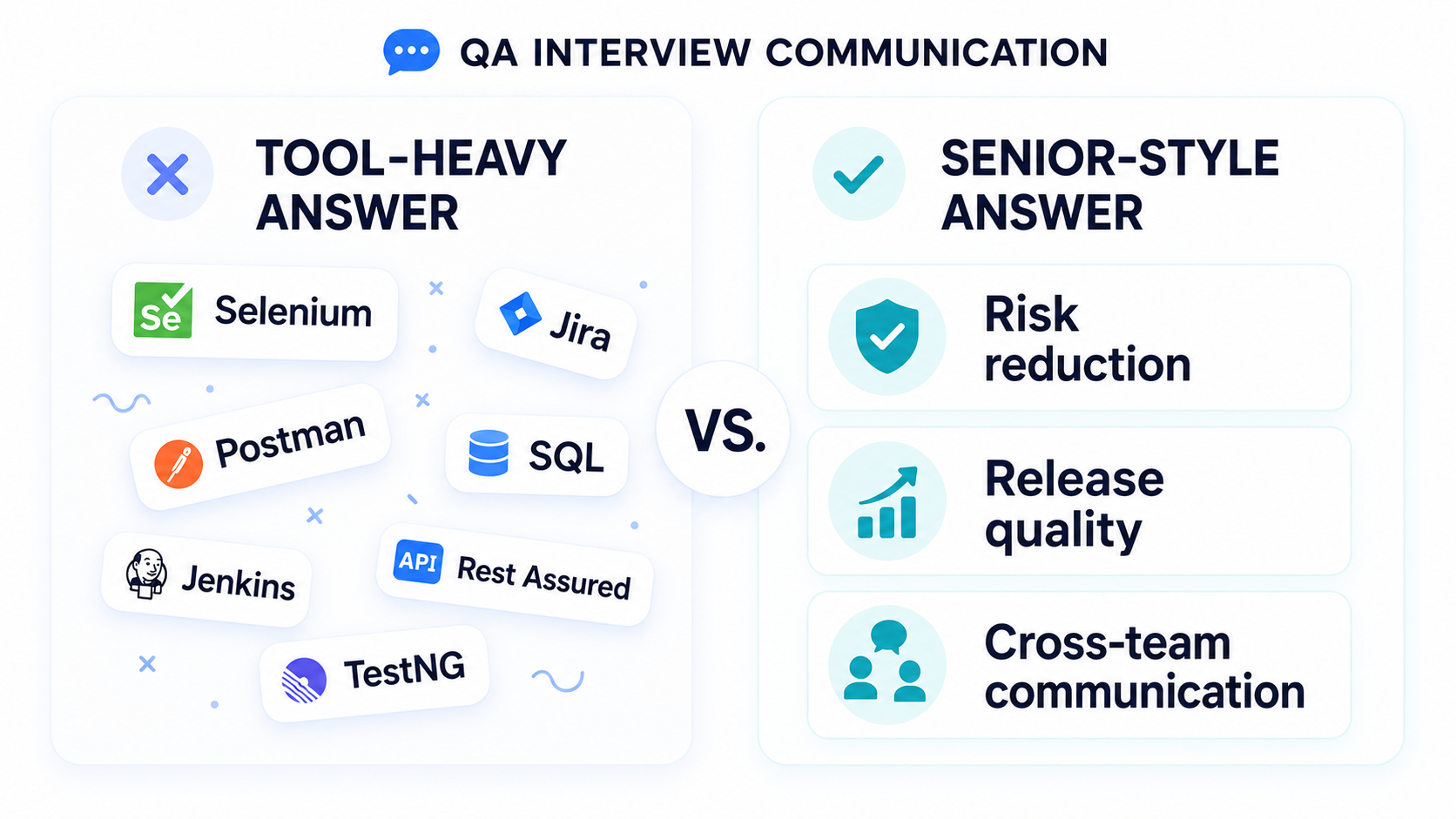
Others overload the answer with tools: “Selenium, Postman, Jira, SQL, Cypress, API testing, regression testing…”
And some stay too abstract: “I’m hardworking, detail-oriented, passionate about quality…”
None of these approaches help the interviewer quickly understand who you are professionally.
A better answer is much simpler:
- where you are now,
- what kind of QA work you specialize in,
- and what you're looking for next.
That's enough.
The simplest structure that works
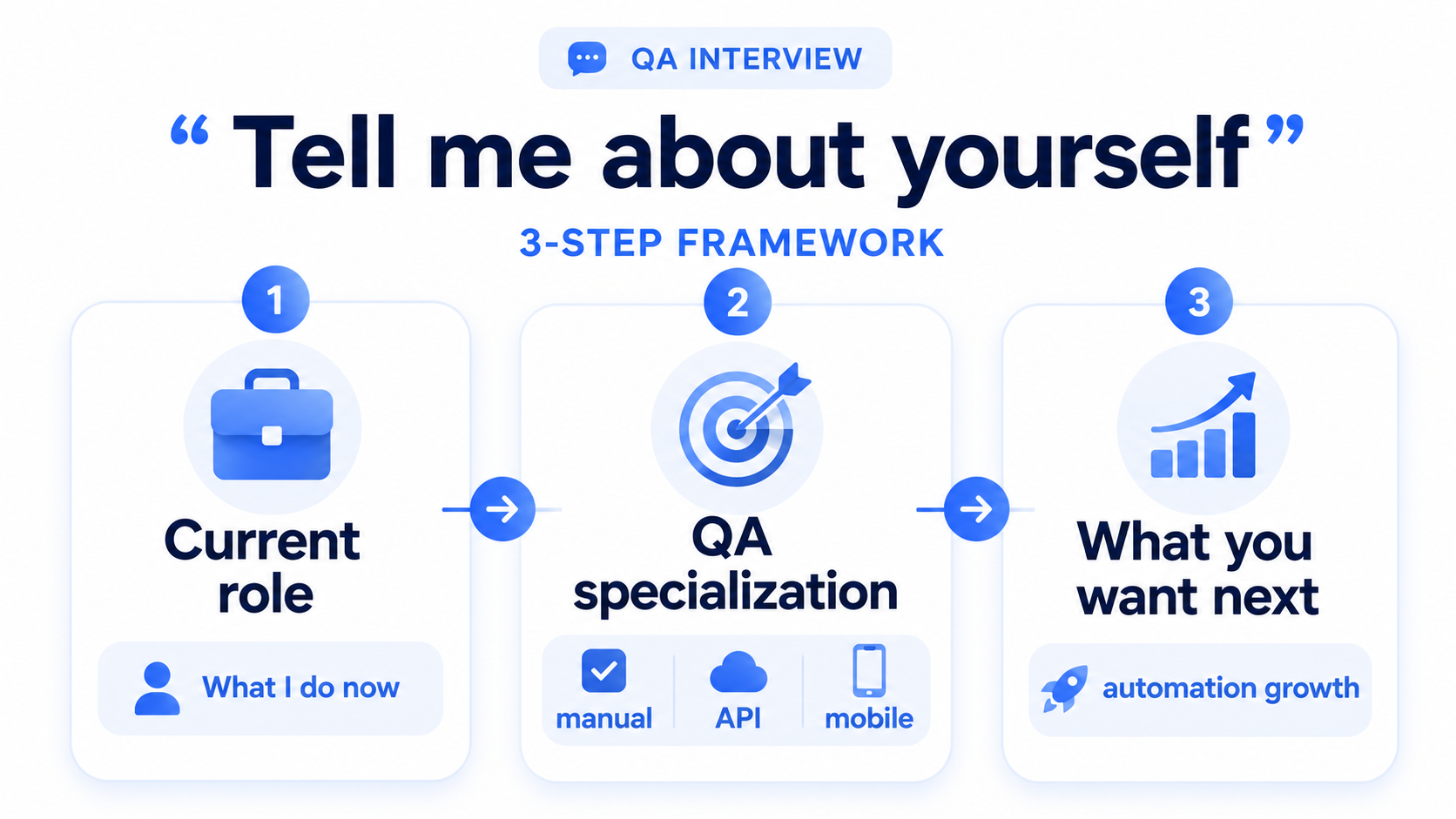
The most reliable framework for QA introductions is:
- Current role or experience level
- Main QA focus and strengths
- What kind of opportunity you're looking for
Not because interviewers demand a formula — but because this structure reduces cognitive load for the listener.
Instead of making the interviewer assemble your story manually, you hand them a clean summary.
Here's what that sounds like in practice.
A strong example answer
Here's a good example for a middle-level QA engineer:
“I'm a QA engineer with around three years of experience, mostly in web and mobile applications. In my current role, I focus mainly on manual testing, regression coverage, and API validation, and I work closely with developers during release cycles.
Over the last year, I've also been improving my automation skills with Cypress and SQL because I want to move toward a more technical QA role.
What I enjoy most about QA is finding edge cases early and helping teams avoid production issues before release.”
Notice what this answer does well:
- it sounds conversational,
- it stays focused,
- and it gives the interviewer multiple directions for follow-up questions.
The answer creates clarity instead of noise.
You do NOT need to mention every technology
One of the biggest misconceptions among QA candidates is that more tools automatically make the answer stronger.
Usually the opposite happens.
Long technology lists are difficult to process verbally — especially in English. Interviewers stop listening after the fifth or sixth item anyway.
Instead of trying to sound comprehensive, try to sound clear.
This:
“I mainly work with API testing and regression testing for web applications.”
is often stronger than:
“I worked with Postman, Selenium, Jira, TestRail, Charles Proxy, SQL, Cypress, Jenkins…”
The second answer sounds like a resume dump. The first sounds like a professional summary.
Key insight: “Tell me about yourself” is not a checklist of technologies. It's a positioning statement.
The biggest English mistake: speaking without direction
For non-native speakers, the hardest part is usually not vocabulary. It's maintaining structure while speaking spontaneously.
Candidates often begin with a clear idea, then start improvising mid-answer:
- adding random details,
- backtracking,
- changing timelines,
- or repeating information.
This creates the feeling of uncertainty — even when the actual experience is strong.
A simple mental rule helps enormously:
One idea per sentence. One topic per paragraph.
You don't need long explanations. You need clean transitions.
For example:
“Right now I mainly focus on manual and API testing.”
“Recently I've also started improving my automation skills.”
“Long term, I'd like to grow toward a more technical QA role.”
Short. Clear. Easy to follow.
That's exactly how strong communicators sound in interviews.
How senior QA engineers usually sound different
Senior candidates rarely try to sound impressive.
Instead, they sound specific and calm.
They speak more about:
- ownership,
- collaboration,
- release quality,
- risk reduction,
- communication,
- and process thinking.
Not just tools.
A junior candidate might say:
“I executed many test cases and found bugs.”
A stronger senior-style version sounds more like:
“I worked closely with developers during releases and focused heavily on catching regression risks before production.”
The second answer sounds more business-aware and collaborative.
That's a big difference in interview perception.
Should you memorize your answer?
You should rehearse it.
You should not memorize it word-for-word.
Fully memorized answers often sound unnatural because your brain becomes focused on recall instead of communication. The moment you forget one sentence, fluency collapses.
Instead, memorize the structure:
- present role,
- specialization,
- growth direction.
Then practice expressing the same ideas slightly differently each time.
That creates flexibility — which sounds much more natural in real interviews.
A practical rehearsal method that actually works
Most candidates prepare this question silently in their head.
That's almost useless.
Interview communication is a spoken skill, not a thinking skill.
A much better approach: record yourself answering the question three times in a row.
After each version, ask:
- Was the structure clear?
- Did I stay concise?
- Did I sound calm?
- Did I repeat myself?
- Did I explain what kind of QA engineer I actually am?
You'll usually notice immediate improvements by the third attempt.
The introduction is usually the first question of a QA loop, not the last. The rest of it — test design, automation, the bug that got through, working with developers — is covered in QA Engineer Interview Questions. And if your next interview isn't for a QA role, the same structure adapted for any round is here: tell me about yourself, three ways.
And if you're using WhalePrep, this process becomes much easier because you can immediately see pacing, filler-word patterns, and clarity issues directly in your feedback.
Practical target: Aim for a 60–90 second introduction that sounds structured, calm, and easy to follow — not maximally detailed.
The goal of “Tell me about yourself” isn't to impress the interviewer with everything you've ever done.
It's to make them think:
“This person communicates clearly. Working with them would probably be easy.”
For QA engineers, that's one of the strongest signals you can give.